Showing posts with label radiation sickness. Show all posts
Showing posts with label radiation sickness. Show all posts
Wednesday, January 15, 2014
ZERO Sardines Along Pacific Coast
I don't eat sardines, however, sardines are the main food source for thousands of sea birds, mammals and fish who are starving without this vital food source.


Thursday, January 2, 2014
The Ocean Is Broken
 Ivan Macfadyen aboard the Funnel Web. Picture by Max Mason-Hubers

IT was the silence that made this voyage different from all of those before it.
Not the absence of sound, exactly.
The wind still whipped the sails and whistled in the rigging. The waves still sloshed against the fibreglass hull.
And there were plenty of other noises: muffled thuds and bumps and scrapes as the boat knocked against pieces of debris.
What was missing was the cries of the seabirds which, on all previous similar voyages, had surrounded the boat.
The birds were missing because the fish were missing.
Exactly
10 years before, when Newcastle yachtsman Ivan Macfadyen had sailed
exactly the same course from Melbourne to Osaka, all he'd had to do to
catch a fish from the ocean between Brisbane and Japan was throw out a
baited line.
"There was not one of the 28
days on that portion of the trip when we didn't catch a good-sized fish
to cook up and eat with some rice," Macfadyen recalled.
But this time, on that whole long leg of sea journey, the total catch was two.
No fish. No birds. Hardly a sign of life at all.
"In years gone by I'd gotten used to all the birds and their noises," he said.
"They'd
be following the boat, sometimes resting on the mast before taking off
again. You'd see flocks of them wheeling over the surface of the sea in
the distance, feeding on pilchards."
But in
March and April this year, only silence and desolation surrounded his
boat, Funnel Web, as it sped across the surface of a haunted ocean.
North of the equator, up above New Guinea, the ocean-racers saw a big fishing boat working a reef in the distance.
"All day it was there, trawling back and forth. It was a big ship, like a mother-ship," he said.
And
all night it worked too, under bright floodlights. And in the morning
Macfadyen was awoken by his crewman calling out, urgently, that the ship
had launched a speedboat.
"Obviously I was
worried. We were unarmed and pirates are a real worry in those waters. I
thought, if these guys had weapons then we were in deep trouble."
But
they weren't pirates, not in the conventional sense, at least. The
speedboat came alongside and the Melanesian men aboard offered gifts of
fruit and jars of jam and preserves.
"And they gave us five big sugar-bags full of fish," he said.
"They were good, big fish, of all kinds. Some were fresh, but others had obviously been in the sun for a while.
"We
told them there was no way we could possibly use all those fish. There
were just two of us, with no real place to store or keep them. They just
shrugged and told us to tip them overboard. That's what they would have
done with them anyway, they said.
"They
told us that his was just a small fraction of one day's by-catch. That
they were only interested in tuna and to them, everything else was
rubbish. It was all killed, all dumped. They just trawled that reef day
and night and stripped it of every living thing."
Macfadyen
felt sick to his heart. That was one fishing boat among countless more
working unseen beyond the horizon, many of them doing exactly the same
thing.
No wonder the sea was dead. No wonder his baited lines caught nothing. There was nothing to catch.
If that sounds depressing, it only got worse.
The
next leg of the long voyage was from Osaka to San Francisco and for
most of that trip the desolation was tinged with nauseous horror and a
degree of fear.
"After we left Japan, it felt as if the ocean itself was dead," Macfadyen said.
"We
hardly saw any living things. We saw one whale, sort of rolling
helplessly on the surface with what looked like a big tumour on its
head. It was pretty sickening.
"I've done a
lot of miles on the ocean in my life and I'm used to seeing turtles,
dolphins, sharks and big flurries of feeding birds. But this time, for
3000 nautical miles there was nothing alive to be seen."
In place of the missing life was garbage in astounding volumes.
"Part
of it was the aftermath of the tsunami that hit Japan a couple of years
ago. The wave came in over the land, picked up an unbelievable load of
stuff and carried it out to sea. And it's still out there, everywhere
you look."
Ivan's brother, Glenn, who
boarded at Hawaii for the run into the United States, marvelled at the
"thousands on thousands" of yellow plastic buoys. The huge tangles of
synthetic rope, fishing lines and nets. Pieces of polystyrene foam by
the million. And slicks of oil and petrol, everywhere.
Countless
hundreds of wooden power poles are out there, snapped off by the killer
wave and still trailing their wires in the middle of the sea.
"In years gone by, when you were becalmed by lack of wind, you'd just start your engine and motor on," Ivan said.
Not this time.
"In
a lot of places we couldn't start our motor for fear of entangling the
propeller in the mass of pieces of rope and cable. That's an unheard of
situation, out in the ocean.
"If we did decide to motor we couldn't do it at night, only in the daytime with a lookout on the bow, watching for rubbish.
"On
the bow, in the waters above Hawaii, you could see right down into the
depths. I could see that the debris isn't just on the surface, it's all
the way down. And it's all sizes, from a soft-drink bottle to pieces the
size of a big car or truck.
"We saw a
factory chimney sticking out of the water, with some kind of boiler
thing still attached below the surface. We saw a big container-type
thing, just rolling over and over on the waves.
"We were weaving around these pieces of debris. It was like sailing through a garbage tip.
"Below
decks you were constantly hearing things hitting against the hull, and
you were constantly afraid of hitting something really big. As it was,
the hull was scratched and dented all over the place from bits and
pieces we never saw."
Plastic was
ubiquitous. Bottles, bags and every kind of throwaway domestic item you
can imagine, from broken chairs to dustpans, toys and utensils.
And
something else. The boat's vivid yellow paint job, never faded by sun
or sea in years gone past, reacted with something in the water off
Japan, losing its sheen in a strange and unprecedented way.
BACK in Newcastle, Ivan Macfadyen is still coming to terms with the shock and horror of the voyage.
"The ocean is broken," he said, shaking his head in stunned disbelief.
Recognising
the problem is vast, and that no organisations or governments appear to
have a particular interest in doing anything about it, Macfadyen is
looking for ideas.
He plans to lobby government ministers, hoping they might help.
More
immediately, he will approach the organisers of Australia's major ocean
races, trying to enlist yachties into an international scheme that uses
volunteer yachtsmen to monitor debris and marine life.
Macfadyen
signed up to this scheme while he was in the US, responding to an
approach by US academics who asked yachties to fill in daily survey
forms and collect samples for radiation testing - a significant concern
in the wake of the tsunami and consequent nuclear power station failure
in Japan.
"I asked them why don't we push for a fleet to go and clean up the mess," he said.
"But
they said they'd calculated that the environmental damage from burning
the fuel to do that job would be worse than just leaving the debris
there."
36 Signs Media Is Lying About Radiation- Still Not Ready To Accept a Harsh Truth?
ael Snyder, on December 31st, 2013

The west coast of the United States is being absolutely fried by radiation from the Fukushima nuclear disaster, and the mainstream media is not telling us the truth about this.
What you are about to see is a collection of evidence that is quite startling. Taken collectively, this body of evidence shows that nuclear radiation from Fukushima is affecting sea life in the Pacific
Ocean and animal life along the west coast of North America in some extraordinary ways. But the mainstream media continues to insist that we don’t have a thing to worry about. The mainstream media continues to insist that radiation levels in the Pacific and along the west coast are perfectly safe.
Are they lying to us?
Evaluate the evidence compiled below and come to your own conclusions…
#1 Independent researchers have measured alarmingly high levels of radiation on the beaches of the west coast. For example, the video posted below was taken on December 23rd, 2013 at Pacifica State Beach. As you can see in this video, radiation levels near the water are up to five times higher than normal background radiation…
#2 According to Oceanus Magazine, the total amount of cesium-137 that has been released into the Pacific Ocean from Fukushima is 10,000 to 100,000 times greater than the amount released into the oceans by the Chernobyl disaster or by the atmospheric nuclear weapons tests of the 1960s.
#3 Former MSNBC host Cenk Uygur has admitted that while he was at MSNBC he was instructed not to warn the public about the radiation coming from Fukushima…
#5 Something is causing starfish all along the west coast of the United States to literally disintegrate into piles of “white goo“…
#8 The recent deaths of thousands of birds in Oregon is absolutely baffling scientists.
#9 Something is causing large numbers of seals and walruses up in Alaska to lose hair and develop “oozing sores”.
#10 Substantial numbers of polar bears along the coast of Alaska are suffering from fur loss and open sores.
#11 There is an epidemic of sea lion deaths along the California coastline.
#12 The population of sockeye salmon along the coastlines of Alaska is at a “historic low”.
#13 Something is causing Pacific herring to bleed from their gills, bellies and eyeballs.
#14 Dangerous levels of cesium-137 have been discovered in mushrooms and berries grown along the west coast.
#15 According to an absolutely shocking report put out by the National Academy of Sciences, it has been proven that Pacific Bluefin tuna have transported radioactive material “across the entire North Pacific Ocean”…
#17 Experts have found very high levels of cesium-137 in plankton living in the waters of the Pacific Ocean between Hawaii and the west coast.
#18 One test in California found that 15 out of 15 Bluefin tuna were contaminated with radiation from Fukushima.
#19 Back in 2012, the Vancouver Sun reported that cesium-137 was being found in a very high percentage of the fish that Japan was selling to Canada…
#20 An EU-funded study concluded that Fukushima released up to 210 quadrillion becquerels of cesium-137 into the atmosphere.
#21 One very experienced Australian adventurer has stated that he felt as though “the ocean itself was dead” as he journeyed from Japan to San Francisco recently…
#23 The deputy chairman of Russia’s State Duma Committee for Natural Resources, Maxim Shingarkin, says that seafood captured off the northwest coast of the United States is so radioactive that it represents a “danger for mankind”…
#26 A senior researcher of marine chemistry at the Japan Meteorological Agency’s Meteorological Research Institute says that “30 billion becquerels of radioactive cesium and 30 billion becquerels of radioactive strontium” are being released into the Pacific Ocean from Fukushima every single day.
#27 According to Tepco, a total of somewhere between 20 trillion and 40 trillion becquerels of radioactive tritium have gotten into the Pacific Ocean since the Fukushima disaster first began.
#28 According to a professor at Tokyo University, 3 gigabecquerels of cesium-137 are flowing into the port at Fukushima Daiichi every single day.
#29 It is being projected that significant levels of cesium-137 will reach every corner of the Pacific Ocean by the year 2020.
#30 It has been estimated that the entire Pacific Ocean will soon “have cesium levels 5 to 10 times higher” than what we witnessed during the era of heavy atomic bomb testing in the Pacific many decades ago.
#31 The immense amount of radioactive material being released into the Pacific Ocean from Fukushima has caused environmental activist Joe Martino to issue the following warning…
#34 According to the Wall Street Journal, it is being projected that the cleanup of Fukushima could take up to 40 years to complete.
#35 Yale Professor Charles Perrow is warning that if the cleanup of Fukushima is not handled with 100% precision that humanity could be threatened “for thousands of years”…
As we enter 2014, we are entering a time when the world is becoming increasingly unstable. The global economy is being shaken, political corruption is seemingly everywhere, evidence of advanced social decay is all around us and the earth itself is starting to groan and crack with increasingly regularity. But the mainstream media continues to insist that everything is going to be just fine. That is one of the reasons why I wrote my new novel.
The American people deserve to hear the truth and be warned about the great challenges that are rapidly approaching.
In the end, millions upon millions of people could end up getting seriously ill as a result of all of this radiation coming from Fukushima. Most of them will never even know why they have gotten sick.
And if there is a major earthquake or a significant accident during the cleanup at Fukushima, we could actually see huge sections of Japan be evacuated permanently.
It would be hard to overstate just how serious all of this is. But you won’t hear about this from the mainstream media. Their story is that “everything is okay” and they are sticking to it.
So what do you think? Please feel free to share your thoughts by posting a comment below…

The west coast of the United States is being absolutely fried by radiation from the Fukushima nuclear disaster, and the mainstream media is not telling us the truth about this.
What you are about to see is a collection of evidence that is quite startling. Taken collectively, this body of evidence shows that nuclear radiation from Fukushima is affecting sea life in the Pacific
Ocean and animal life along the west coast of North America in some extraordinary ways. But the mainstream media continues to insist that we don’t have a thing to worry about. The mainstream media continues to insist that radiation levels in the Pacific and along the west coast are perfectly safe.
Are they lying to us?
Evaluate the evidence compiled below and come to your own conclusions…
#1 Independent researchers have measured alarmingly high levels of radiation on the beaches of the west coast. For example, the video posted below was taken on December 23rd, 2013 at Pacifica State Beach. As you can see in this video, radiation levels near the water are up to five times higher than normal background radiation…
#2 According to Oceanus Magazine, the total amount of cesium-137 that has been released into the Pacific Ocean from Fukushima is 10,000 to 100,000 times greater than the amount released into the oceans by the Chernobyl disaster or by the atmospheric nuclear weapons tests of the 1960s.
#3 Former MSNBC host Cenk Uygur has admitted that while he was at MSNBC he was instructed not to warn the public about the radiation coming from Fukushima…
“I was on MSNBC at the time when this happened, I said, “Don’t trust what the Japanese government is saying, they’ll say trust what the electric power company is saying. Go, go, go, get outta there. Get as far away from that plant as you can. It’s literally a core meltdown.” And they always don’t want people to panic, so they were always like, “Oh it’s going to be okay.” [...] I’m like, “You’re crazy man, don’t be anywhere near that reactor.” And I remember at the time, of course not at The Young Turks, but on cable news, people were like, “Hey Cenk, you know, I don’t know that you want to say that, because the official government position is that it’s safe.” Oh, is that the official government position? Now go explain that to the people who served on the USS Ronald Reagan.”#4 71 U.S. sailors who assisted with the initial Fukushima relief efforts have developed serious diseases such as testicular cancer, thyroid cancer, Leukemia, “unremitting gynecological bleeding” and brain tumors since that time as a result of exposure to radiation coming from Fukushima.
#5 Something is causing starfish all along the west coast of the United States to literally disintegrate into piles of “white goo“…
Researchers say nuclear pollution from the 2011 earthquake in Japan that damaged the Fukushima Nuclear Power Plant could be partially to blame for a disease wiping out starfish along the West Coast.#6 Bald eagles are dying in unprecedented numbers in Utah, and nobody can figure out why this is happening…
Dr. Peter Raimondi of the University of Santa Cruz says something is making starfish susceptible to whats believed to be a bacteria coined “Wasting Disease.” It essentially disintegrate the marine invertebrates into a white goo, after the starfish loses its legs.
Bald eagles are dying in Utah — 20 in the past few weeks alone — and nobody can figure out why.
Hundreds of the majestic birds — many with wing spans of 7 feet or more — migrate here each winter, gathering along the Great Salt Lake and feasting on carp and other fish that swim in the nearby freshwater bays.#7 Huge numbers of dead birds are dropping dead and washing up along the coastlines of Alaska. It is being reported that many of the carcases of the dead birds are “broken open and bleeding”.
Earlier this month, however, hunters and farmers across five counties in northern and central Utah began finding the normally skittish raptors lying listless on the ground. Many suffered from seizures, head tremors and paralysis in the legs, feet and wings.
#8 The recent deaths of thousands of birds in Oregon is absolutely baffling scientists.
#9 Something is causing large numbers of seals and walruses up in Alaska to lose hair and develop “oozing sores”.
#10 Substantial numbers of polar bears along the coast of Alaska are suffering from fur loss and open sores.
#11 There is an epidemic of sea lion deaths along the California coastline.
#12 The population of sockeye salmon along the coastlines of Alaska is at a “historic low”.
#13 Something is causing Pacific herring to bleed from their gills, bellies and eyeballs.
#14 Dangerous levels of cesium-137 have been discovered in mushrooms and berries grown along the west coast.
#15 According to an absolutely shocking report put out by the National Academy of Sciences, it has been proven that Pacific Bluefin tuna have transported radioactive material “across the entire North Pacific Ocean”…
“We report unequivocal evidence that Pacific Bluefin tuna, Thunnus orientalis, transported Fukushima-derived radionuclides across the entire North Pacific Ocean.”#16 Something seems to be causing a substantial spike in the death rate for killer whales living off of the coast of British Columbia.
#17 Experts have found very high levels of cesium-137 in plankton living in the waters of the Pacific Ocean between Hawaii and the west coast.
#18 One test in California found that 15 out of 15 Bluefin tuna were contaminated with radiation from Fukushima.
#19 Back in 2012, the Vancouver Sun reported that cesium-137 was being found in a very high percentage of the fish that Japan was selling to Canada…
• 73 percent of the mackerel
• 91 percent of the halibut
• 92 percent of the sardines
• 93 percent of the tuna and eel
• 94 percent of the cod and anchovies
• 100 percent of the carp, seaweed, shark and monkfish
#21 One very experienced Australian adventurer has stated that he felt as though “the ocean itself was dead” as he journeyed from Japan to San Francisco recently…
The next leg of the long voyage was from Osaka to San Francisco and for most of that trip the desolation was tinged with nauseous horror and a degree of fear.
“After we left Japan, it felt as if the ocean itself was dead,” Macfadyen said.
“We hardly saw any living things. We saw one whale, sort of rolling helplessly on the surface with what looked like a big tumour on its head. It was pretty sickening.
“I’ve done a lot of miles on the ocean in my life and I’m used to seeing turtles, dolphins, sharks and big flurries of feeding birds. But this time, for 3000 nautical miles there was nothing alive to be seen.”
In place of the missing life was garbage in astounding volumes.#22 It is being projected that the radioactivity of coastal waters off the U.S. west coast could double over the next five to six years.
“Part of it was the aftermath of the tsunami that hit Japan a couple of years ago. The wave came in over the land, picked up an unbelievable load of stuff and carried it out to sea. And it’s still out there, everywhere you look.”
#23 The deputy chairman of Russia’s State Duma Committee for Natural Resources, Maxim Shingarkin, says that seafood captured off the northwest coast of the United States is so radioactive that it represents a “danger for mankind”…
“Currents in the world ocean are so structured that the areas of seafood capture near the U.S. northwest coast are more likely to contain radioactive nuclides than even the Sea of Okhotsk, which is much closer to Japan. These products are the main danger for mankind because they can find their way to people’s tables on a massive scale.”#24 According to one recent scientific report, radiation from Fukushima could affect our seafood for “many generations” and ultimately kill more than a million people…
This cycle will last for many generations, because of the food chain of fish and other marine fauna, and the radioactivity will be recycled and in fact the meat content will increase rather than decreasing by decay. Even if only one one-hundredth of the radioactivity (more than 1e15 Bq of CS137) were to enter this recirculation pattern, the collective whole body ingestion dose over many generations would exceed 1e7 Sv, sufficient to kill more than 1,000,000 people.#25 The Japanese government has estimated that approximately 300 tons of highly radioactive water is pouring into the Pacific Ocean from the destroyed Fukushima nuclear facility every single day.
#26 A senior researcher of marine chemistry at the Japan Meteorological Agency’s Meteorological Research Institute says that “30 billion becquerels of radioactive cesium and 30 billion becquerels of radioactive strontium” are being released into the Pacific Ocean from Fukushima every single day.
#27 According to Tepco, a total of somewhere between 20 trillion and 40 trillion becquerels of radioactive tritium have gotten into the Pacific Ocean since the Fukushima disaster first began.
#28 According to a professor at Tokyo University, 3 gigabecquerels of cesium-137 are flowing into the port at Fukushima Daiichi every single day.
#29 It is being projected that significant levels of cesium-137 will reach every corner of the Pacific Ocean by the year 2020.
#30 It has been estimated that the entire Pacific Ocean will soon “have cesium levels 5 to 10 times higher” than what we witnessed during the era of heavy atomic bomb testing in the Pacific many decades ago.
#31 The immense amount of radioactive material being released into the Pacific Ocean from Fukushima has caused environmental activist Joe Martino to issue the following warning…
“Your days of eating Pacific Ocean fish are over.”#32 The Iodine-131, Cesium-137 and Strontium-90 that are constantly being released from Fukushima are going to affect the health of those living in the northern hemisphere for a very, very long time. Just consider what Harvey Wasserman had to say about this…
Iodine-131, for example, can be ingested into the thyroid, where it emits beta particles (electrons) that damage tissue. A plague of damaged thyroids has already been reported among as many as 40 percent of the children in the Fukushima area. That percentage can only go higher. In developing youngsters, it can stunt both physical and mental growth. Among adults it causes a very wide range of ancillary ailments, including cancer.
Cesium-137 from Fukushima has been found in fish caught as far away as California. It spreads throughout the body, but tends to accumulate in the muscles.#33 Outdoor radiation levels at Fukushima recently hit a new all-time high.
Strontium-90’s half-life is around 29 years. It mimics calcium and goes to our bones.
#34 According to the Wall Street Journal, it is being projected that the cleanup of Fukushima could take up to 40 years to complete.
#35 Yale Professor Charles Perrow is warning that if the cleanup of Fukushima is not handled with 100% precision that humanity could be threatened “for thousands of years”…
“Conditions in the unit 4 pool, 100 feet from the ground, are perilous, and if any two of the rods touch it could cause a nuclear reaction that would be uncontrollable. The radiation emitted from all these rods, if they are not continually cool and kept separate, would require the evacuation of surrounding areas including Tokyo. Because of the radiation at the site the 6,375 rods in the common storage pool could not be continuously cooled; they would fission and all of humanity will be threatened, for thousands of years.”#36 There are very alarming reports that new “unexplained plumes of radioactive steam” are rising at Fukushima. Japanese officials are not able to get inside and see what is causing these plumes. Some are speculating that the crisis at Fukushima just got a whole lot worse. The following is from a recent Ecologist article…
Unexplained plumes of radioactive steam have been rising from Fukushima’s Reactor Building 3, Could a major meltdown be on the way?
Fukushima’s Reactor Building 3 exploded on 13th March 2011 as a result of a hydrogen buildup, breaching the building’s containment and emitting a huge plume of radiation.
The reactor itself is in meltdown.
And now fresh plumes of steam have been seen coming out the structure. These have now been confirmed by Tepco, the owner of the nuclear plant, from 19th December onwards. The company believes the steam is coming from the fifth floor of the building.If a full-blown meltdown does happen at Fukushima, it would be an environmental disaster unlike anything that we have ever seen before in human history.
However it does not know the cause of the steam. Lethal levels of radiation and the physical damage to the structure have so far made entry and inspection impossible.
As we enter 2014, we are entering a time when the world is becoming increasingly unstable. The global economy is being shaken, political corruption is seemingly everywhere, evidence of advanced social decay is all around us and the earth itself is starting to groan and crack with increasingly regularity. But the mainstream media continues to insist that everything is going to be just fine. That is one of the reasons why I wrote my new novel.
The American people deserve to hear the truth and be warned about the great challenges that are rapidly approaching.
In the end, millions upon millions of people could end up getting seriously ill as a result of all of this radiation coming from Fukushima. Most of them will never even know why they have gotten sick.
And if there is a major earthquake or a significant accident during the cleanup at Fukushima, we could actually see huge sections of Japan be evacuated permanently.
It would be hard to overstate just how serious all of this is. But you won’t hear about this from the mainstream media. Their story is that “everything is okay” and they are sticking to it.
So what do you think? Please feel free to share your thoughts by posting a comment below…
Saturday, December 28, 2013
Fukushima Far Worse Than Chernobyl

Photo: EPA
Three years on, the general public
is still nervous about the Fukushima Daiichi nuclear power plant
disaster of March 2011. Heavy rain has caused more contaminated water
leaks over the protection dike recently.
The Japanese are increasingly
distrustful of atomic scientists' claims that the contaminated water has
failed to make it to the ocean. Meanwhile, The Cape Cod Times US newspapers reports that the Fukushima toxic waste is reaching the US West Coast, while 70 crewmembers of the US Ronald Reagan
aircraft-carrier, involved in the relief operation in the wake of the
disaster, are filing a lawsuit against the TEPCO Fukushima operator
company, claiming the Japanese company had failed to warn them of all
the risks that they were running during the operation.
USS Ronald Reaganwas
riding athwart in the radioactive discharge plume 10 miles away from
the crippled Fukushima plant. The crew desalinated seawater to use it in
cooking, with some crewmembers developing cancerous diseases and/or
becoming blind as a result.
The
contamination of the ocean within the 10-mile zone of the nuclear power
plant is due to the fact that some of the reactor nuclear decay
products made it to the ocean, rather than to the air, as was the case
in Chernobyl in 1986. Currents take harmful agents to great distances,
so the seafood and fish that are caught in the contaminated currents
even in other parts of the world may still prove a health hazard, says
the Deputy Chairman of the State Duma Committee on Natural Resources, Maxim Shingarkin.
"Because
of the World Ocean currents, the seafood that's caught off the US
Pacific coast is more likely to contain radionuclides than the seafood
in the Sea of Okhotsk, which is by far closer to Japan. It is these
marine products that may find their way to the tables of different
countries' residents that pose the gravest danger," he said.
Contaminated
fish may have been caught and delivered anywhere. From now on one
should bear in mind that it's impossible to check the entire fish catch
for radiation. This is what the co-chairman of the Eco-Protection
international environmental group, Vladimir Slivyak, says about the situation in a comment.
"Russia
has been considering setting limits on catching marine products and
fish in the Far East. But no restrictions have officially been imposed
thus far, to the best of my knowledge. But some moves may eventually be
made," he said.
As
regards atmospheric contamination, the crippled Fukushima plant
radionuclides are known to have reached California and Mexico eight days
after the disaster. Russia was unaffected by the propagation of
radiation, says Maxim Shingarkin.
"The
radioactive discharges to the atmosphere had failed to focus on either
the Sea of Okhotsk, or Sakhalin Island, or the Far East, or the Kuril
Islands. Besides, radiation transfer through the air has so far posed
little or no danger. But let's wait and see, for not all fuel has been
removed from the damaged nuclear reactors yet. We can therefore expect
atmospheric radiation releases as a result of the heating up of
reactors," he said.
It
took years in the wake of the Chernobyl accident to draw more accurate
conclusions about the scale of radioactive contamination. The situation
around Fukushima seems to be pretty much the same, says Vladimir
Slivyak, and elaborates.
"We
are likely to learn about the detailed consequences of the Fukushima
nuclear disaster in a matter of 10 to 15 years. It is clear that a great
deal of fisheries, water grass areas and actually anything in the ocean
has been contaminated. Fukushima radiation is understandably spreading
across the world. It is obvious that large areas have been contaminated
in Japan. But it will take years of research to get a more detailed
picture of the Fukushima disaster consequences," he said.
Meanwhile,
tests in California found that the blue-fin tuna caught in coastal
waters were contaminated, according to the globalresearchreport.com
portal. The contaminated water has most likely reached the area, since
radioactive iodine levels have grown more than 200 times.
The level of
caesium-137 has also grown along the entire length of the US West Coast,
the radioactive caesium was found in local berries and mushrooms.
Meanwhile, local residents have reported more frequent bird deaths
recently. Radionuclides have made it even to the Alaskan coast, causing a
decline in the sockeye populations there. Some experts claim we are yet
to see more consequences of the 2011 Fukushima nuclear power plant
disaster.
Tuesday, December 10, 2013
Unreported Animal Die-offs And Radiation Affecting United States
Radiation reaching the United States from the nuclear meltdowns in Fukushima, Japan is causing significant harm; affecting newborn Human babies in California, Pacific Ocean sea life, and even inland wild life. Radiation is causing massive die-offs of sea life as well as mammals, birds and reptiles inland. High percentages of inland animals that are not already dead are losing their fur, bleeding from lesions all over their bodies and failing to reproduce.
Radiation contamination of sea food is already confirmed and contamination of the inland food supply is now taking place as rain carries radiation from the Pacific ocean to inland farms. U.S. Government propagandists are claiming everything is all right – but they aren’t even monitoring radiation levels – while scientists outside the government are warning the worst is yet to come. Newly released government projections (contained in this article) show parts of Hawaii, Alaska and the entire west coast of North America may become uninhabitable due to radioactive Cesium-137 making its way toward us in the Pacific.
HOW IT ALL BEGAN
The Fukushima Daiichi nuclear disaster was a nuclear energy accident at the Fukushima I Nuclear Power Plant, caused by an earthquake and, later, a tsunami (tidal wave) generated by that earthquake on 11 March 2011. The tsunami caused equipment failures and without this equipment, coolant stopped flowing into the reactor cores allowing them to get so hot, they melted. During the meltdowns, radioactive materials were released into the air and water beginning on March 12, 2011. Fukushima is the largest nuclear disaster since the Chernobyl disaster of 1986 and the second disaster (along with Chernobyl) to measure Level 7 on the International Nuclear Event Scale.
The plant comprised six separate boiling water reactors originally designed by General Electric (GE) and maintained by the Tokyo Electric Power Company (TEPCO).
At the time of the earthquake, reactor 4 had been De-fueled and reactors 5 and 6 were in cold shutdown for planned maintenance. Immediately after the earthquake, following government regulations, the remaining reactors 1, 2 and 3 shut down automatically, inserting control rods in what is termed a “SCRAM event.” Following this, emergency diesel generators came online to power electronics and coolant systems which operated right up until the tsunami. The tsunami arrived 50 minutes after the initial earthquake. The 13 meter (40 Feet) tall tsunami tidal wave overwhelmed the plant’s seawall, which was only 10 meters (30 feet) high.
The tsunami water flooded rooms in which the emergency generators were housed. The flooded diesel generators failed, cutting power to the critical pumps that must continuously circulate coolant water through a reactor to keep the fuel rods from melting down. Even though the control rods had come down and the nuclear reactions had halted, the fuel rods remained red hot following the SCRAM event. In fact, the rods remained hot enough to melt themselves down when no adequate cold sink was available.
Once the diesel generators failed from the tsunami flooding, secondary emergency cooling pumps kicked-in; they were run by batteries. One day later, the batteries died for the secondary emergency pumps. The pumps stopped and the reactors began to overheat due to lack of water to cool the fuel rods. As workers struggled to supply power to the reactors coolant systems and restore power to their control rooms, the overheating reactors released hydrogen gas; an incredibly explosive gas. A number of hydrogen-air chemical explosions occurred, the first in Unit 1, on March 12 and the last in Unit 4, on March 15. These explosions tore the reactor buildings apart, and did severe damage to whatever cooling systems remained; making them all but useless.
EXPLOSIONS OBLITERATE THREE REACTORS
The first explosion took place on March 12. The remaining explosions took place by March 15. The results are shown below:
CONGRESSIONAL RESEARCH SERVICE EXPLAINS THE DANGER
In 2012, the Congressional Research Service reported to Congress as follows:
“As it approaches the west coast of North America, the North Pacific Current splits into the southward California Current and the northward Alaska Current. Although these currents have the potential for bringing radiation from Japan’s Fukushima Daiichi nuclear accident to U.S. waters, their flow is slow … Regardless of the slow flow, radioactive contaminants with long half-lives (e.g., cesium-137, with a half-life of about 30 years) could still pose concerns if transported over long distances by ocean currents.”
Scientists at the Woods Hole Oceanographic Institution advised that radiation levels in seafood should continue to be monitored … there remains the potential for a corridor of highly contaminated water leading away from Japan and a very patchy distribution of contaminated fish; extensive monitoring will determine the exact dispersion of these radioactive contaminants. [...]
It has been suggested that cesium-137 may move up the food chain and become concentrated in fish muscle or that radiation hot spots may occur. Another potential concern is related to accumulation of strontium-90 in fish bone [...] additional radiation from [Fukushima] might eventually also be detected in North Pacific waters under U.S. jurisdiction, even months after its release. Regardless of slow ocean transport, the long half-life of radioactive cesium isotopes means that radioactive contaminants could remain a valid concern for years.
FOOD CONTAMINATION
On March 30, 2011, Mr. Lake Barrett, a former official with the U.S. Nuclear Regulatory Commission and now an adviser to TEPCO, said “The environmental release is the growing challenge; you’re going to read more and more about it in the paper. Wait until the first cesium-137 shows up in Alaska salmon, which is only a matter of time.” Mr. Barrett’s warning was prescient.
In 2012, out of twenty Pacific Tuna fish caught and tested from various points in the ocean, one hundred percent (100%) tested positive for radiation contamination! Researchers at Stanford University studied samples from 20 blue-fin tuna caught off California between May and August 2012 and said they detected radioactive cesium. They concluded the source of the contamination was the nuclear accident at the Fukushima Daiichi plant.
In British Columbia, Canada, Pacific Herring have been found to be bleeding from their eyes, mouths, fins and tails. Independent fisheries scientist Alexandra Morton is raising concerns about a “disease” she says is spreading through Pacific herring causing fish to hemorrhage. “I did a beach seine on Malcolm Island [near Port McNeill on northern Vancouver Island] and I got approximately 100 of these little herring and they were not only bleeding from their fins, but their bellies, their chins, their eyeballs. “It was 100 per cent … I couldn’t find any that weren’t bleeding to some degree.”
Morton dragged up several hundred of the fish and found the trouble had spread – instead of their usual silver color the fish had eyes, tails, underbellies, gills and faces plastered with blood. “I have never seen fish that looked this bad,” In June, the affected fish were only found in eastern Johnstone Strait, but have since spread to Alert Bay and Sointula, she said.
COVER-UP BY TEPCO OF MASSIVE AND ONGOING RADIATION LEAKING INTO PACIFIC OCEAN
On July 22, 2013, more than two years after the incident, it was revealed that the plant has been leaking 300 Tons of heavily contaminated radioactive water into the Pacific OceanEVERY DAY since the accident of March 11, 2011, something long suspected by local fishermen and independent investigators. TEPCO had previously denied this was happening and the situation prompted Japanese Prime Minister Shinzō Abe to order the government to step in. It was then revealed how — and how much — radiation is pouring into the Pacific Ocean:
On August 20, 2013 in a further incident, it was announced that an ADDITIONAL 300 metric tons of heavily contaminated water had also leaked from a storage tank at the plant and had gone into ground water and into the Pacific. What this means is that the water pouring out of that plant today is just as poisonous as the water that came out the first day this accident took place; and it has been that way for over 1,000 days — and counting!
Scientists at the University of Alaska are concerned because some radiation has arrived in northern Alaska and along its west coast. That’s raised concern over contamination of fish and wildlife. More may be heading toward coastal communities like Haines and Skagway.
Douglas Dasher, a researcher at the University of Alaska Fairbanks, says radiation levels in Alaskan waters could reach Cold War levels. “The levels they are projecting in some of the models are in the ballpark of what they saw in the North Pacific in the 1960s,” he said. Those levels occurred after the US conducted open-air blasts of nuclear weapons in the south Pacific.
This contamination is taking place because the major ocean currents running east from Japan, split as they approach the North American continent; part of the current heads north toward Alaska, the other part heads south toward the U.S. west coast. Those currents are carrying highly radioactive water from the Fukushima disaster throughout the Pacific ocean.
NOVEMBER, 2013: SHARP INCREASE IN U.S. EFFECTS
In November, 2013, enormous amounts of Star Fish on the sea floor off the California coast have begun dissolving into mushy piles of white goo. During an ocean dive Thursday morning, November 7, 2013 off the coast of Santa Cruz, Pete Raimondi [UCSC ecology professor] watched two halves of a broken sea star ravaged by a “wasting syndrome” walk away from each other. Not long after, they would turn into mushy piles of goo, disintegrated by a disease that has so far perplexed scientists. It appears the syndrome is impacting as many as 10 sea star species up and down the West Coast, wiping out entire populations in certain areas.
“They can go from great — to pieces — in 12 hours,” said Raimondi. The Pacific Ocean is in the middle of a cooling trend, so biologists are at a loss to explain the outbreak. Others, speaking to Turner Radio Network on condition of anonymity fearing retaliation from authorities, said the cause has already been identified: radiation poisoning. These biologists have been threatened with losing their jobs if they reveal this publicly.
On November 11, 2013 FOX NEWS reported that since June, researchers have seen the disease spread from as far as British Columbia, Canada, down through California and, within the past year, from Maine through New Jersey. The scientists tracking the disease find this simultaneous bi-coastal infection especially alarming. “There is no direct route to get from Providence to Seattle,” Gary Wessel, a molecular biologist at Brown University. However, when one considers the evaporation of radiation-contaminated water from the Pacific, being carried inland by weather systems, and the jet stream then carrying those weather systems to the east coast, the explanation becomes obvious.
On November 23, 2013, thousands of dead sea birds began washing up on the shores of Alaska. Many of the carcases were broken open and bleeding.
The toxic effects of radiation on sea life is getting so terrible it is actually causing sea creatures to flee the deep ocean and head toward the shores.On November 24, the New York Times reported: It began with the anchovies, miles and miles of them … in the waters of Monterey Bay.
Then the sea lions came, by the thousands … then pelicans … bottlenose dolphins in groups of 100 or more have been spotted. But it was the whales that astounded even longtime residents — more than 200 humpbacks … and, on a recent weekend, a pod of 19 rowdy Orcas … the water in every direction roiled with mammals.
For almost three months, Monterey and nearby coastal areas have played host to a mammoth convocation of sea life that scientists here say is unprecedented in their memories … never that anyone remembers have there been this many or have they stayed so long. Last month, so many anchovies crowded into Santa Cruz harbor that the oxygen ran out, leading to a major die-off.
Marine researchers PUBLICLY say they are baffled about the reason for the anchovy explosion. PRIVATELY, they tell the Turner Radio Network the cause is Fukushima radiation but they’ve been told to keep quiet to avoid causing a public panic. INLAND WILDLIFE BADLY AFFECTED
According to a November report by the U.S. Geological Survey: Alopecia (loss of fur) and skin lesions were recently observed in polar bears off the northern coast of Alaska. According to the Alaska Region Marine Mammal Stranding Network since the spring of 2012, a total of 23 polar bears from Barrow, Deadhorse and Kaktovik have been identified with variable degrees of hair loss/ thinning, inflamed and crusting skin, and oral lesions. The prevalence of these symptoms appears to be in about 28% of observed animals.
The concurrent presence of hair loss in seals, walrus and polar bears has suggested a possible connection between the events. Biologists in Alaska have observed a high rate of non-viable eggs in nests of greater white-fronted geese. Northern fur seals and soil samples in Alaska are also showing unusual signs. In another study, the Alaska Science Center has documented surprisingly high mortality (20–30 percent) of adult female musk ox during mid- to late summer in northwestern Alaska.
In Montana, Wyoming and inland to Minnesota, the effects of Fukushima are already being seen. According to the Billings (Montana) Gazette, Nov. 18, 2013: Jared Jansen said, he and his father, Mike, have seen up to 100 dead deer at a time along the Musselshell River. … die-offs have whittled the once hardy deer herds down to a handful. “I’ve only seen three does this year. . . It used to be when I was haying along the river, early in the morning, I’d see 200 to 500 head in the meadows.”
The reasons attributed to these die-offs sound like something out of a science fiction thriller: epizootic hemorrhagic disease, sylvatic plague, bluetongue, brucellosis, chytrid, chronic wasting disease … Yet the all-too-real afflictions threaten to reduce the populations of wild mammals, birds and reptiles across Montana, Wyoming and other regions.
“There is a general consensus among scientists that we are seeing more disease,” said Jonathan Sleeman, director of the U.S. Geological Survey’s National Wildlife Health Center in Madison, Wis. . . so many diseases afflicting such a wide variety of animals … A study is being conducted in northwestern Montana to examine the possible causes.” Others within the USGS who asked to remain anonymous for fear of their jobs say that radiation is the cause, but the government won’t admit it because there is nothing they can do about it.
In Minnesota, the Independent Record newspaper Oct. 31, 2013 reports Moose in the northern United States are dying … The die-off is most dire in Minnesota, where ecologists say moose could be gone within a decade. Concerns have prompted a 10-year study of moose in Montana. It’s not just in Montana, either. An aerial survey of moose in northeastern Minnesota earlier this year showed a 52 percent drop in population, which prompted the Minnesota Department of Natural Resources to completely call off the 2013 moose hunting season. In various regions of British Columbia [Canada], populations have declined from 20 to 70 percent in recent years.
HUMAN BABIES IN CALIFORNIA ALREADY SHOWING SIGNS OF RADIATION EXPOSURE
A new study of the effects of tiny quantities of radioactive fallout from Fukushima on the health of babies born in California shows a significant excess of hypothyroidism caused by the radioactive contamination traveling 5,000 miles across the Pacific.
The article will be published next week in the peer-reviewed journal Open Journal of Pediatrics. Congenital hypothyroidism is a rare but serious condition normally affecting about one child in 2,000, and one that demands clinical intervention – the growth of children suffering from the condition is affected if they are left untreated. All babies born in California are monitored at birth for Thyroid Stimulating Hormone (TSH) levels in blood, since high levels indicate hypothyroidism.
Joe Mangano and Janette Sherman of the Radiation and Public Health Project in New York, and Christopher Busby, guest researcher at Jacobs University, Bremen, examined congenital hypothyroidism (CH) rates in newborns using data obtained from the State of California over the period of the Fukushima explosions.
Their results are published in their paper Changes in confirmed plus borderline cases of congenital hypothyroidism in California as a function of environmental fallout from the Fukushima nuclear meltdown. The researchers compared data for babies exposed to radioactive Iodine-131 and born between March 17th and Dec 31st 2011 with unexposed babies born in 2011 before the exposures plus those born in 2012.
Confirmed cases of hypothyroidism, defined as those with TSH level greater than 29 units increased by 21% in the group of babies that were exposed to excess radioactive Iodine in the womb. The same group of children had a 27% increase in ‘borderline cases’.
RADIATION ALERTS ISSUED FOR MULTIPLE U.S. CITIES - NO MEDIA COVERAGE
The Nuclear Emergency Tracking Center (NETC) provides free radiation monitoring information to the public from about 300 private monitoring sites and many more government monitoring sites like “RADnet” from the U.S. Environmental Protection Agency (EPA).
In the past ten days, the Nuclear Emergency Tracking Center (NETC) has issued radiation alerts for several major U.S. cities after background radiation levels in those cities suddenly spiked to record high levels or jumped to fifty percent higher than normal in the “Counts Per Minute” (CPM) of deadly Gamma Radiation in the 600 – 800 keV range. Those Alerts are known as “RADCON – 5″ Alerts because the radiation has climbed to the highest level on the 5 step scale. Despite the issuance of RADCON-5 Alerts, no mass-media in ANY of those cities, bothered to report the condition. Cities affected were / are:
OLYMPIA, WASHINGTON
RICHLAND, WASHINGTON
RENO, NEVADA
JUNEAU, ALASKA
COMPARISON TO READINGS AT FUKUSHIMA Now that you’ve seen the numbers here in the U.S., take a look at the reading at Fukushima itself:
AREAS OF THE USA, CANADA, EXPECTED TO BECOME UNINHABITABLE
The graphic below, (File is 14.4 MB May Take Time to Load) produced by the National Oceanographic and Atmospheric Administration (NOAA) an agency of the United States Government, shows the MONTHLY predicted spread and potency of radioactive Cesium-137 from Fukushima throughout the Pacific Ocean. The GIF runs from March, 2011 when the disaster took place, all the way through to the year 2041.
Based upon these projections, northernmost Hawaii will be uninhabitable by January, 2015. The government is concealing this to protect real estate values and tourism because there’s nothing the government can do to stop the radiation.
By October, 2016, all of southern Alaska including the Aleutian Islands will be uninhabitable. The government is concealing this to protect the fishing industry because there’s nothing the government can do to stop the radiation.
By June, 2017, the entire west coast of Canada and the United States will be uninhabitable. Both the U.S. and Canadian governments are concealing this to avoid a panic, to preserve real estate values in some of the wealthiest areas of both countries, to preserve farming and fishing industries in those areas from being driven out of business when consumers shun their products due to radiation contamination and because there is nothing the governments can do to stop the radiation.
(Note: The government projection below uses only 1/3rd the amount of Cesium that was actually released initially and DOES NOT take into account the 300 metric tons of contaminated water which has leaked into the Pacific Ocean EVERY DAY since the accident in March, 2011.)
To simply download the file above, right-click here and select “Save Link As”
EXPERTS: THE WORST IS YET TO COME
Beginning on Tuesday, November 26, 2013, TEPCO is to begin attempting to remove the 1,534 used fuel rods that remain inside Reactor #4. These rods contain pellets of nuclear materials like Uranium and Plutonium as well as other radioactive materials. Experts say that the fuel rods may snap during the removal process because the reactor pool is physically damaged and the rods may not be able to come out perfectly straight.
In the event a rod snaps, and fuel pellets fall out from inside the rod onto the floor of the reactor pool, they could begin reacting with each other on the floor of the pool. They would become self-sustaining mini reactors, completely uncontrollable, boiling-off the pool water, thereby allowing the remaining fuel rods to overheat and meltdown and releasing tons of radioactive gases into the atmosphere. One byproduct of such a scenario would be large amounts of hydrogen gas. The temporary structure built around Reactor #4 after the earthquake, would hold enough of that hydrogen gas to make the equivalent of a nuclear explosion once the gas ignites.
Experts say that if such a scenario takes place as TEPCO is removing the remaining fuel rods, “it is bye-bye Japan and people on the west coast of the United States and Canada would have only DAYS to evacuate to avoid lethal doses of radiation.”
- See more at: http://healthydebates.com/unreported-animal-die-offs-radiation-affecting-united-states/#sthash.lE78O4ll.dpuf
Radiation contamination of sea food is already confirmed and contamination of the inland food supply is now taking place as rain carries radiation from the Pacific ocean to inland farms. U.S. Government propagandists are claiming everything is all right – but they aren’t even monitoring radiation levels – while scientists outside the government are warning the worst is yet to come. Newly released government projections (contained in this article) show parts of Hawaii, Alaska and the entire west coast of North America may become uninhabitable due to radioactive Cesium-137 making its way toward us in the Pacific.
HOW IT ALL BEGAN
The Fukushima Daiichi nuclear disaster was a nuclear energy accident at the Fukushima I Nuclear Power Plant, caused by an earthquake and, later, a tsunami (tidal wave) generated by that earthquake on 11 March 2011. The tsunami caused equipment failures and without this equipment, coolant stopped flowing into the reactor cores allowing them to get so hot, they melted. During the meltdowns, radioactive materials were released into the air and water beginning on March 12, 2011. Fukushima is the largest nuclear disaster since the Chernobyl disaster of 1986 and the second disaster (along with Chernobyl) to measure Level 7 on the International Nuclear Event Scale.
The plant comprised six separate boiling water reactors originally designed by General Electric (GE) and maintained by the Tokyo Electric Power Company (TEPCO).
At the time of the earthquake, reactor 4 had been De-fueled and reactors 5 and 6 were in cold shutdown for planned maintenance. Immediately after the earthquake, following government regulations, the remaining reactors 1, 2 and 3 shut down automatically, inserting control rods in what is termed a “SCRAM event.” Following this, emergency diesel generators came online to power electronics and coolant systems which operated right up until the tsunami. The tsunami arrived 50 minutes after the initial earthquake. The 13 meter (40 Feet) tall tsunami tidal wave overwhelmed the plant’s seawall, which was only 10 meters (30 feet) high.
The tsunami water flooded rooms in which the emergency generators were housed. The flooded diesel generators failed, cutting power to the critical pumps that must continuously circulate coolant water through a reactor to keep the fuel rods from melting down. Even though the control rods had come down and the nuclear reactions had halted, the fuel rods remained red hot following the SCRAM event. In fact, the rods remained hot enough to melt themselves down when no adequate cold sink was available.
Once the diesel generators failed from the tsunami flooding, secondary emergency cooling pumps kicked-in; they were run by batteries. One day later, the batteries died for the secondary emergency pumps. The pumps stopped and the reactors began to overheat due to lack of water to cool the fuel rods. As workers struggled to supply power to the reactors coolant systems and restore power to their control rooms, the overheating reactors released hydrogen gas; an incredibly explosive gas. A number of hydrogen-air chemical explosions occurred, the first in Unit 1, on March 12 and the last in Unit 4, on March 15. These explosions tore the reactor buildings apart, and did severe damage to whatever cooling systems remained; making them all but useless.
EXPLOSIONS OBLITERATE THREE REACTORS
The first explosion took place on March 12. The remaining explosions took place by March 15. The results are shown below:
CONGRESSIONAL RESEARCH SERVICE EXPLAINS THE DANGER
In 2012, the Congressional Research Service reported to Congress as follows:
“As it approaches the west coast of North America, the North Pacific Current splits into the southward California Current and the northward Alaska Current. Although these currents have the potential for bringing radiation from Japan’s Fukushima Daiichi nuclear accident to U.S. waters, their flow is slow … Regardless of the slow flow, radioactive contaminants with long half-lives (e.g., cesium-137, with a half-life of about 30 years) could still pose concerns if transported over long distances by ocean currents.”
Scientists at the Woods Hole Oceanographic Institution advised that radiation levels in seafood should continue to be monitored … there remains the potential for a corridor of highly contaminated water leading away from Japan and a very patchy distribution of contaminated fish; extensive monitoring will determine the exact dispersion of these radioactive contaminants. [...]
It has been suggested that cesium-137 may move up the food chain and become concentrated in fish muscle or that radiation hot spots may occur. Another potential concern is related to accumulation of strontium-90 in fish bone [...] additional radiation from [Fukushima] might eventually also be detected in North Pacific waters under U.S. jurisdiction, even months after its release. Regardless of slow ocean transport, the long half-life of radioactive cesium isotopes means that radioactive contaminants could remain a valid concern for years.
FOOD CONTAMINATION
On March 30, 2011, Mr. Lake Barrett, a former official with the U.S. Nuclear Regulatory Commission and now an adviser to TEPCO, said “The environmental release is the growing challenge; you’re going to read more and more about it in the paper. Wait until the first cesium-137 shows up in Alaska salmon, which is only a matter of time.” Mr. Barrett’s warning was prescient.
In 2012, out of twenty Pacific Tuna fish caught and tested from various points in the ocean, one hundred percent (100%) tested positive for radiation contamination! Researchers at Stanford University studied samples from 20 blue-fin tuna caught off California between May and August 2012 and said they detected radioactive cesium. They concluded the source of the contamination was the nuclear accident at the Fukushima Daiichi plant.
In British Columbia, Canada, Pacific Herring have been found to be bleeding from their eyes, mouths, fins and tails. Independent fisheries scientist Alexandra Morton is raising concerns about a “disease” she says is spreading through Pacific herring causing fish to hemorrhage. “I did a beach seine on Malcolm Island [near Port McNeill on northern Vancouver Island] and I got approximately 100 of these little herring and they were not only bleeding from their fins, but their bellies, their chins, their eyeballs. “It was 100 per cent … I couldn’t find any that weren’t bleeding to some degree.”
Morton dragged up several hundred of the fish and found the trouble had spread – instead of their usual silver color the fish had eyes, tails, underbellies, gills and faces plastered with blood. “I have never seen fish that looked this bad,” In June, the affected fish were only found in eastern Johnstone Strait, but have since spread to Alert Bay and Sointula, she said.
COVER-UP BY TEPCO OF MASSIVE AND ONGOING RADIATION LEAKING INTO PACIFIC OCEAN
On July 22, 2013, more than two years after the incident, it was revealed that the plant has been leaking 300 Tons of heavily contaminated radioactive water into the Pacific OceanEVERY DAY since the accident of March 11, 2011, something long suspected by local fishermen and independent investigators. TEPCO had previously denied this was happening and the situation prompted Japanese Prime Minister Shinzō Abe to order the government to step in. It was then revealed how — and how much — radiation is pouring into the Pacific Ocean:
On August 20, 2013 in a further incident, it was announced that an ADDITIONAL 300 metric tons of heavily contaminated water had also leaked from a storage tank at the plant and had gone into ground water and into the Pacific. What this means is that the water pouring out of that plant today is just as poisonous as the water that came out the first day this accident took place; and it has been that way for over 1,000 days — and counting!
Scientists at the University of Alaska are concerned because some radiation has arrived in northern Alaska and along its west coast. That’s raised concern over contamination of fish and wildlife. More may be heading toward coastal communities like Haines and Skagway.
Douglas Dasher, a researcher at the University of Alaska Fairbanks, says radiation levels in Alaskan waters could reach Cold War levels. “The levels they are projecting in some of the models are in the ballpark of what they saw in the North Pacific in the 1960s,” he said. Those levels occurred after the US conducted open-air blasts of nuclear weapons in the south Pacific.
This contamination is taking place because the major ocean currents running east from Japan, split as they approach the North American continent; part of the current heads north toward Alaska, the other part heads south toward the U.S. west coast. Those currents are carrying highly radioactive water from the Fukushima disaster throughout the Pacific ocean.
NOVEMBER, 2013: SHARP INCREASE IN U.S. EFFECTS
In November, 2013, enormous amounts of Star Fish on the sea floor off the California coast have begun dissolving into mushy piles of white goo. During an ocean dive Thursday morning, November 7, 2013 off the coast of Santa Cruz, Pete Raimondi [UCSC ecology professor] watched two halves of a broken sea star ravaged by a “wasting syndrome” walk away from each other. Not long after, they would turn into mushy piles of goo, disintegrated by a disease that has so far perplexed scientists. It appears the syndrome is impacting as many as 10 sea star species up and down the West Coast, wiping out entire populations in certain areas.
“They can go from great — to pieces — in 12 hours,” said Raimondi. The Pacific Ocean is in the middle of a cooling trend, so biologists are at a loss to explain the outbreak. Others, speaking to Turner Radio Network on condition of anonymity fearing retaliation from authorities, said the cause has already been identified: radiation poisoning. These biologists have been threatened with losing their jobs if they reveal this publicly.
On November 11, 2013 FOX NEWS reported that since June, researchers have seen the disease spread from as far as British Columbia, Canada, down through California and, within the past year, from Maine through New Jersey. The scientists tracking the disease find this simultaneous bi-coastal infection especially alarming. “There is no direct route to get from Providence to Seattle,” Gary Wessel, a molecular biologist at Brown University. However, when one considers the evaporation of radiation-contaminated water from the Pacific, being carried inland by weather systems, and the jet stream then carrying those weather systems to the east coast, the explanation becomes obvious.
On November 23, 2013, thousands of dead sea birds began washing up on the shores of Alaska. Many of the carcases were broken open and bleeding.
The toxic effects of radiation on sea life is getting so terrible it is actually causing sea creatures to flee the deep ocean and head toward the shores.On November 24, the New York Times reported: It began with the anchovies, miles and miles of them … in the waters of Monterey Bay.
Then the sea lions came, by the thousands … then pelicans … bottlenose dolphins in groups of 100 or more have been spotted. But it was the whales that astounded even longtime residents — more than 200 humpbacks … and, on a recent weekend, a pod of 19 rowdy Orcas … the water in every direction roiled with mammals.
For almost three months, Monterey and nearby coastal areas have played host to a mammoth convocation of sea life that scientists here say is unprecedented in their memories … never that anyone remembers have there been this many or have they stayed so long. Last month, so many anchovies crowded into Santa Cruz harbor that the oxygen ran out, leading to a major die-off.
Marine researchers PUBLICLY say they are baffled about the reason for the anchovy explosion. PRIVATELY, they tell the Turner Radio Network the cause is Fukushima radiation but they’ve been told to keep quiet to avoid causing a public panic. INLAND WILDLIFE BADLY AFFECTED
According to a November report by the U.S. Geological Survey: Alopecia (loss of fur) and skin lesions were recently observed in polar bears off the northern coast of Alaska. According to the Alaska Region Marine Mammal Stranding Network since the spring of 2012, a total of 23 polar bears from Barrow, Deadhorse and Kaktovik have been identified with variable degrees of hair loss/ thinning, inflamed and crusting skin, and oral lesions. The prevalence of these symptoms appears to be in about 28% of observed animals.
The concurrent presence of hair loss in seals, walrus and polar bears has suggested a possible connection between the events. Biologists in Alaska have observed a high rate of non-viable eggs in nests of greater white-fronted geese. Northern fur seals and soil samples in Alaska are also showing unusual signs. In another study, the Alaska Science Center has documented surprisingly high mortality (20–30 percent) of adult female musk ox during mid- to late summer in northwestern Alaska.
In Montana, Wyoming and inland to Minnesota, the effects of Fukushima are already being seen. According to the Billings (Montana) Gazette, Nov. 18, 2013: Jared Jansen said, he and his father, Mike, have seen up to 100 dead deer at a time along the Musselshell River. … die-offs have whittled the once hardy deer herds down to a handful. “I’ve only seen three does this year. . . It used to be when I was haying along the river, early in the morning, I’d see 200 to 500 head in the meadows.”
The reasons attributed to these die-offs sound like something out of a science fiction thriller: epizootic hemorrhagic disease, sylvatic plague, bluetongue, brucellosis, chytrid, chronic wasting disease … Yet the all-too-real afflictions threaten to reduce the populations of wild mammals, birds and reptiles across Montana, Wyoming and other regions.
“There is a general consensus among scientists that we are seeing more disease,” said Jonathan Sleeman, director of the U.S. Geological Survey’s National Wildlife Health Center in Madison, Wis. . . so many diseases afflicting such a wide variety of animals … A study is being conducted in northwestern Montana to examine the possible causes.” Others within the USGS who asked to remain anonymous for fear of their jobs say that radiation is the cause, but the government won’t admit it because there is nothing they can do about it.
In Minnesota, the Independent Record newspaper Oct. 31, 2013 reports Moose in the northern United States are dying … The die-off is most dire in Minnesota, where ecologists say moose could be gone within a decade. Concerns have prompted a 10-year study of moose in Montana. It’s not just in Montana, either. An aerial survey of moose in northeastern Minnesota earlier this year showed a 52 percent drop in population, which prompted the Minnesota Department of Natural Resources to completely call off the 2013 moose hunting season. In various regions of British Columbia [Canada], populations have declined from 20 to 70 percent in recent years.
HUMAN BABIES IN CALIFORNIA ALREADY SHOWING SIGNS OF RADIATION EXPOSURE
A new study of the effects of tiny quantities of radioactive fallout from Fukushima on the health of babies born in California shows a significant excess of hypothyroidism caused by the radioactive contamination traveling 5,000 miles across the Pacific.
The article will be published next week in the peer-reviewed journal Open Journal of Pediatrics. Congenital hypothyroidism is a rare but serious condition normally affecting about one child in 2,000, and one that demands clinical intervention – the growth of children suffering from the condition is affected if they are left untreated. All babies born in California are monitored at birth for Thyroid Stimulating Hormone (TSH) levels in blood, since high levels indicate hypothyroidism.
Joe Mangano and Janette Sherman of the Radiation and Public Health Project in New York, and Christopher Busby, guest researcher at Jacobs University, Bremen, examined congenital hypothyroidism (CH) rates in newborns using data obtained from the State of California over the period of the Fukushima explosions.
Their results are published in their paper Changes in confirmed plus borderline cases of congenital hypothyroidism in California as a function of environmental fallout from the Fukushima nuclear meltdown. The researchers compared data for babies exposed to radioactive Iodine-131 and born between March 17th and Dec 31st 2011 with unexposed babies born in 2011 before the exposures plus those born in 2012.
Confirmed cases of hypothyroidism, defined as those with TSH level greater than 29 units increased by 21% in the group of babies that were exposed to excess radioactive Iodine in the womb. The same group of children had a 27% increase in ‘borderline cases’.
RADIATION ALERTS ISSUED FOR MULTIPLE U.S. CITIES - NO MEDIA COVERAGE
The Nuclear Emergency Tracking Center (NETC) provides free radiation monitoring information to the public from about 300 private monitoring sites and many more government monitoring sites like “RADnet” from the U.S. Environmental Protection Agency (EPA).
In the past ten days, the Nuclear Emergency Tracking Center (NETC) has issued radiation alerts for several major U.S. cities after background radiation levels in those cities suddenly spiked to record high levels or jumped to fifty percent higher than normal in the “Counts Per Minute” (CPM) of deadly Gamma Radiation in the 600 – 800 keV range. Those Alerts are known as “RADCON – 5″ Alerts because the radiation has climbed to the highest level on the 5 step scale. Despite the issuance of RADCON-5 Alerts, no mass-media in ANY of those cities, bothered to report the condition. Cities affected were / are:
OLYMPIA, WASHINGTON
RICHLAND, WASHINGTON
RENO, NEVADA
JUNEAU, ALASKA
COMPARISON TO READINGS AT FUKUSHIMA Now that you’ve seen the numbers here in the U.S., take a look at the reading at Fukushima itself:
AREAS OF THE USA, CANADA, EXPECTED TO BECOME UNINHABITABLE
The graphic below, (File is 14.4 MB May Take Time to Load) produced by the National Oceanographic and Atmospheric Administration (NOAA) an agency of the United States Government, shows the MONTHLY predicted spread and potency of radioactive Cesium-137 from Fukushima throughout the Pacific Ocean. The GIF runs from March, 2011 when the disaster took place, all the way through to the year 2041.
Based upon these projections, northernmost Hawaii will be uninhabitable by January, 2015. The government is concealing this to protect real estate values and tourism because there’s nothing the government can do to stop the radiation.
By October, 2016, all of southern Alaska including the Aleutian Islands will be uninhabitable. The government is concealing this to protect the fishing industry because there’s nothing the government can do to stop the radiation.
By June, 2017, the entire west coast of Canada and the United States will be uninhabitable. Both the U.S. and Canadian governments are concealing this to avoid a panic, to preserve real estate values in some of the wealthiest areas of both countries, to preserve farming and fishing industries in those areas from being driven out of business when consumers shun their products due to radiation contamination and because there is nothing the governments can do to stop the radiation.
(Note: The government projection below uses only 1/3rd the amount of Cesium that was actually released initially and DOES NOT take into account the 300 metric tons of contaminated water which has leaked into the Pacific Ocean EVERY DAY since the accident in March, 2011.)
To simply download the file above, right-click here and select “Save Link As”
EXPERTS: THE WORST IS YET TO COME
Beginning on Tuesday, November 26, 2013, TEPCO is to begin attempting to remove the 1,534 used fuel rods that remain inside Reactor #4. These rods contain pellets of nuclear materials like Uranium and Plutonium as well as other radioactive materials. Experts say that the fuel rods may snap during the removal process because the reactor pool is physically damaged and the rods may not be able to come out perfectly straight.
In the event a rod snaps, and fuel pellets fall out from inside the rod onto the floor of the reactor pool, they could begin reacting with each other on the floor of the pool. They would become self-sustaining mini reactors, completely uncontrollable, boiling-off the pool water, thereby allowing the remaining fuel rods to overheat and meltdown and releasing tons of radioactive gases into the atmosphere. One byproduct of such a scenario would be large amounts of hydrogen gas. The temporary structure built around Reactor #4 after the earthquake, would hold enough of that hydrogen gas to make the equivalent of a nuclear explosion once the gas ignites.
Experts say that if such a scenario takes place as TEPCO is removing the remaining fuel rods, “it is bye-bye Japan and people on the west coast of the United States and Canada would have only DAYS to evacuate to avoid lethal doses of radiation.”
- See more at: http://healthydebates.com/unreported-animal-die-offs-radiation-affecting-united-states/#sthash.lE78O4ll.dpuf
Friday, December 6, 2013
Are We All Eating Fukushima Radioactive Fallout?
In my estimation all of the food in the Northern Hemisphere,
including organic, has the potential of having Fukushima radiation fall
on it. Since March 11, 2011, I have been heavily supplementing and
detoxing myself and all of my animals.
This radiation isn't a surprise, it has been happening every day for 24/7 and will continue for generations to come. It could only get worse if the fuel rod removal from Reactor 4 get loose!
You can learn of my Top 50 Radiation Solutions to minimize harmful effects from radiation ..
I intend to take extra precautions for the remainder of my life, learn more about Radiation Detox
For my garden, I use Zeolite in the soil prior to planting and also built a greenhouse to eliminate fallout. For my animals, I put Bentonite clay in their water and they will choose water with clay every time, rather than plain water.
Stay healthy.
Toni
This radiation isn't a surprise, it has been happening every day for 24/7 and will continue for generations to come. It could only get worse if the fuel rod removal from Reactor 4 get loose!
You can learn of my Top 50 Radiation Solutions to minimize harmful effects from radiation ..
I intend to take extra precautions for the remainder of my life, learn more about Radiation Detox
For my garden, I use Zeolite in the soil prior to planting and also built a greenhouse to eliminate fallout. For my animals, I put Bentonite clay in their water and they will choose water with clay every time, rather than plain water.
Stay healthy.
Toni
Monday, December 2, 2013
Study finds giant strontium-90 release into body of water begins around 1,000 days after meltdown — Dec. 5, 2013 = thousand days after 3/11 — Graphic shows very high levels being discharged for up to 50,000 days
Background information on Fukushima
Arjun Makhijani, nuclear expert and President of the Institute for Energy and Environmental Research: Ground water is contacting the molten fuel and becoming extremely contaminated [...] The fuel is molten and the bottom of the reactor building is undoubtedly damaged. So that’s why the ground water flowing past the trenches and pipes and past the basement of the reactor building is getting into the reactor building where the molten fuel is. It may also be that the molten fuel is in the cracks of the foundation.
Associated Press: The turbine buildings at the Fukushima Dai-ichi plant are about 150 meters (500 feet) from the ocean. According to a Japan Atomic Energy Agency document, the contaminated underground water is spreading toward the sea at a rate of about 4 meters (13 feet) a month. At that rate, “the water from that area is just about to reach the coast,” if it hasn’t already, said Atsunao Marui, an underground water expert [...] on a government committee studying the contaminated water problem. “We must contain the problem as quickly as possible.”
German study from early 1990s parallels situation at Fukushima

International Radiation Protection Association,
1992: “After a core meltdown accident it cannot be completely ruled out
that the melt will reach, and partly penetrate, the concrete
foundation. The amounts of some radionuclides leached out by the passing
groundwater are estimated. The transport of dissolved radionuclides in
groundwater is simulated by an analytical dispersion model [...] a core
meltdown accident could well cause the melt to penetrate into the
reactor foundation and pass through it down to the bottom side of the
foundation within five days.
Even if the passing groundwater were to prevent complete melt-through, there would still be a direct contact of the groundwater with the re-solidified melt surface through fissures, cracks, etc., which could cause the fission products to be leached. [...] Figure 1a shows the concentration in the groundwater and in the river water 500 m away from the reactor between 100 days and 100,000 days . The groundwater was assumed to be discharged into the river water 500 m from the reactor [...] The highest radionuclide concentration of approx. 10^10 Bq/m3 [10 billion Bq/m3] is reached by Sr-90 after some 5,000 days.”
According to Figure 1a, strontium-90 levels stay near zero for the first 1,000 days, after which levels spike to dramatically and appear to remain elevated for the next 50,000 or so days. Though Fukushima is more than 3X closer to the water than the reactor in this study, it is more than 3X slower (0.133 meters/day vs. 0.5 m/d). And of course, Fukushima is dealing with three melted reactor cores, not one.
So when will it be 10^3 [or 1,000] days after 3/11? December 5, 2013, which is this Thursday.
Regarding strontium-90, marine chemist Ken Buesseler from Woods Hole Oceanographic Institution said, “Our biggest concern right now is if some of the other isotopes such as strontium 90 which tend to be more mobile, get through these sediments in the ground water [...] They are entering the oceans at levels that then will accumulate in seafood and will cause new health concerns.”
The study lists several ways to try and mitigate the contamination: Installing impermeable walls around the plant, pumping off the groundwater, using extraction pumps, and freezing the soil.
However, Buesseler said, “Any contamination in the groundwater would eventually flow into the ocean. That is very difficult to stop even with barriers.” The AP writes that Buesseler’s research suggests “contaminated water from the reactor-turbine areas is already leaking into the sea.”
Arjun Makhijani, nuclear expert and President of the Institute for Energy and Environmental Research: Ground water is contacting the molten fuel and becoming extremely contaminated [...] The fuel is molten and the bottom of the reactor building is undoubtedly damaged. So that’s why the ground water flowing past the trenches and pipes and past the basement of the reactor building is getting into the reactor building where the molten fuel is. It may also be that the molten fuel is in the cracks of the foundation.
Associated Press: The turbine buildings at the Fukushima Dai-ichi plant are about 150 meters (500 feet) from the ocean. According to a Japan Atomic Energy Agency document, the contaminated underground water is spreading toward the sea at a rate of about 4 meters (13 feet) a month. At that rate, “the water from that area is just about to reach the coast,” if it hasn’t already, said Atsunao Marui, an underground water expert [...] on a government committee studying the contaminated water problem. “We must contain the problem as quickly as possible.”
German study from early 1990s parallels situation at Fukushima
Figure
1a: Radionuclide concentrations in groundwater and river water — X axis
represents days since the initial meltdown (10^3 = 1,000 days; 10^4 =
10,000 days; 10^5 = 100,000 days)
Even if the passing groundwater were to prevent complete melt-through, there would still be a direct contact of the groundwater with the re-solidified melt surface through fissures, cracks, etc., which could cause the fission products to be leached. [...] Figure 1a shows the concentration in the groundwater and in the river water 500 m away from the reactor between 100 days and 100,000 days . The groundwater was assumed to be discharged into the river water 500 m from the reactor [...] The highest radionuclide concentration of approx. 10^10 Bq/m3 [10 billion Bq/m3] is reached by Sr-90 after some 5,000 days.”
According to Figure 1a, strontium-90 levels stay near zero for the first 1,000 days, after which levels spike to dramatically and appear to remain elevated for the next 50,000 or so days. Though Fukushima is more than 3X closer to the water than the reactor in this study, it is more than 3X slower (0.133 meters/day vs. 0.5 m/d). And of course, Fukushima is dealing with three melted reactor cores, not one.
So when will it be 10^3 [or 1,000] days after 3/11? December 5, 2013, which is this Thursday.
Regarding strontium-90, marine chemist Ken Buesseler from Woods Hole Oceanographic Institution said, “Our biggest concern right now is if some of the other isotopes such as strontium 90 which tend to be more mobile, get through these sediments in the ground water [...] They are entering the oceans at levels that then will accumulate in seafood and will cause new health concerns.”
The study lists several ways to try and mitigate the contamination: Installing impermeable walls around the plant, pumping off the groundwater, using extraction pumps, and freezing the soil.
However, Buesseler said, “Any contamination in the groundwater would eventually flow into the ocean. That is very difficult to stop even with barriers.” The AP writes that Buesseler’s research suggests “contaminated water from the reactor-turbine areas is already leaking into the sea.”
Dead/Dying Sea Stars In West Seattle Video
Dead/Dying seastars in West Seattle (with opening footage to show same site last year) from Laura James on Vimeo.
Please report on the starfish you see on dives... (and on the beach)
Upload a picture of the beach (topside) where you saw sick stars to instagram with the hashtag #sickstarfish This will put it on a map we are putting together. You will need to make sure geolocation is "on" and you are uploading from the site (not from your house). We are also working on a manual add for the site, but that is not up and running yet.
If you dive at a site that has no sick seastars please upload #nosickseastars that way we can get a baseline as well, and actually see spread over time. Tidepool walkers are also encouraged to become involved as the purple starfish are often visible on low tides and you will be able to see melting sea stars.
This is where data will be showing up in real time at sickstarfish.com
Enter more data at the University of Southern California's page.
eeb.ucsc.edu/pacificrockyintertidal/data-products/sea-star-wasting/index.html
Site: Cove 1, Seacrest, West Seattle, Washington State.
Video: Laura James Dive Buddy: Jan Shaw
Camera: 5DMK2 Housing: Subal Lights: Light & Motion SOLA 2000 X 2
Tuesday, November 26, 2013
Unprecedented concentration of sea creatures near shore in California; escaping radiation?

MONTEREY, Calif. — It began with the anchovies, miles and miles of them, their silvery blue bodies thick in the waters of Monterey Bay.
Large numbers of whales have congregated off Monterey
Bay to the delight of camera-wielding whale watchers like the ones
aboard Nancy Black’s Sea Wolf II.

Sea lions have also been attracted by an enormous late bloom of anchovies.

Jim Wilson/The New York Times
Guests on the Sea Wolf II examined a piece of the filter system in a whale’s mouth.
Then the sea lions came, by the thousands, from up and down the
California coast, and the pelicans, arriving in one long V-formation
after another. Fleets of bottlenose dolphins joined them.
But it was the whales that astounded even longtime residents — more than
200 humpbacks lunging, breaching, blowing and tail flapping — and, on a
recent weekend, a pod of 19 rowdy orcas that briefly crashed the party,
picking off sea lions along the way.
“I can’t tell you where to look,” Nancy Black, a marine biologist
leading a boat full of whale watchers last week, said as the water in
every direction roiled with mammals. “It’s all around.”
For almost three months, Monterey and nearby coastal areas have played
host to a mammoth convocation of sea life that scientists here say is
unprecedented in their memories, inviting comparisons to African scenes
like the wildebeest migration or herds of antelope on the Serengeti.
Humpback whales, pelicans and sea lions are all common summer sights off
the Monterey coast, with its nutrient-rich waters. But never that
anyone remembers have there been this many or have they stayed so long,
feeding well into November.
“It’s a very strange year,” said Baldo Marinovic, a research biologist with the Institute for Marine Sciences at the University of California, Santa Cruz.
What has drawn the animals is a late bloom of anchovies so enormous that
continuous, dense blankets of the diminutive fish are visible on depth
sounders. The sea lions, sea birds and humpbacks (which eat an average
of two tons of fish a day) appear to have hardly made a dent in the
population. Last month, so many anchovies crowded into Santa Cruz harbor
that the oxygen ran out, leading to a major die-off.
Marine researchers are baffled about the reason for the anchovy explosion.
“The $64,000 question is why this year?” said Dr. Marinovic, who noted
that anchovies had been unusually scarce for the last five or six years
and that when they do thrive, they usually appear in the spring and
early summer.
He and other scientists speculated that a convergence of factors — a
milder than usual fall, a strong upwelling of colder water, the cycling
of water temperatures in the bay — have created what Dr. Marinovic
called “the perfect storm.”
“Now they’re all kind of concentrating on the coast,” he said of the
anchovies. “They seem to seek out Monterey Bay because the water tends
to be a little warmer and the eggs will develop quickly.” The fish, he
said, “are providing a feast for all these things that feed on them.”
The frenzy has been a boon for whale-watching companies like Monterey Bay Whale Watch, of which Ms. Black is the owner, and for their customers.
In a normal season, passengers are lucky to see one or two humpbacks and
a single whale breaching. On the trip last week, more than 60 whales
were spotted feeding in the deep water of the canyon offshore, and the
breaches were almost too numerous to count — in one case, two whales
arced their bodies out of the water in unison, like competitors in an
Olympic synchronized swimming event.
Foul-smelling whale breath
occasionally permeated the air. Ms. Black said that for the first time this year — she has studied
whales here since 1986, specializing in orcas — she has seen evidence
that the humpbacks are feeding cooperatively with groups of thousands of
sea lions.
The sea lions dive simultaneously, surfacing a few minutes
later. They herd the anchovies into tight balls, called bait balls, and
the whales scoop them up, several hundred in a mouthful. Food is
plentiful enough that the giant cetaceans — an adult male humpback
measures 45 to 50 feet in length, Ms. Black said, and weighs a ton per
foot — can afford to take breaks to play.
The humpback population off the California coast, once rapidly
decreasing, has rebounded with restrictions on hunting, to about 2,000,
experts say. Many whales and sea lions have been congregating to feed
near the rim of the Monterey Submarine Canyon offshore. Bottlenose
dolphins — groups of 100 or more have been spotted this year — feed
closer in.
In most years, the humpbacks would have departed for Mexico weeks ago
and the pelicans flown south. But with the anchovies still in abundance,
no one is sure how long they will stay. They could remain through
December, scientists said, or depart any day.
“I hope it doesn’t end,” Ms. Black said. “But it will.”
Fukushiima Radiation Headed Toward SoCal Beaches
Not a lot of good news has been coming out of Japan lately. This week
at the United Nations COP 19 climate talks meeting in Warsaw it was
announced that Japan will renege on its carbon emissions pledge.
This means that instead of lowering its emissions of greenhouse gases
by 2020 its emissions will actually increase based on 1990 levels. The
reason Japanese officials give is because of the shutdown of its fifty
nuclear power plants, which will mean more reliance on fossil fuels to
meet its energy needs.
Of course, the shutting down of the nuke plants is not a bad thing, especially in light of the Fukushima disaster which until very recently seems to have been suffering from a bit of a news blackout by the mainstream corporate media. This is especially troubling given the imminent passage of a new censorship law in Japan that could make reporting news about Fukushima a crime in the name of protecting state’s secrets (gee, sound familiar?).
How much you know about the situation on the ground at the crippled Daiichi plant depends on how much you are intentionally seeking the information. Many people I talk to still don’t seem to fully comprehend the scope of the problem, likely because it hasn’t dominated the evening news. There is a lot to know but the most troubling facts are
1), that 300 tons of radioactive water have been spilling into the Pacific Ocean every day and is seeping into the groundwater; 2) the clean-up process is so risky that it continues to be delayed and has been called the world’s It’s also been called “the potentially the biggest ticking time bomb in human history.”
The crisis is obviously bad enough for the Japanese, but what keeps me awake at night is the radioactive plume making its way across the Pacific. It worries me because I live in a Southern California beach community, and as surfers committed to a healthy lifestyle, my family and I spend a lot of time in the ocean. I think also of the many Native nations in the US and Canada whose ancient ways of life depend on the “big waters” of the Pacific and this is just the newest threat to those ways.
Perceptions of the seriousness of the radioactive plume (to say nothing of the radiation being released into the atmosphere) seem to, not surprisingly, run along ideological lines between those who support nuclear energy and those who don’t. On the anti-nuclear side, high profile experts such as Helen Caldicott and David Suzuki mince no words about the danger it poses, especially to the North American west coast, to say nothing of all the life in the ocean. Other more conservative industry experts tend to downplay the seriousness of the radioactive plume, saying the ocean will dilute the radioactive particles to negligible levels. Naturally, they are critical of the anti-nuke voices.
The proliferation of nuclear energy is a symptom of the insanity of Western-based modern science. It is reflective of a people who have so little respect for life that they are willing to sacrifice their own grandchildren’s generation to satisfy today’s desires for wealth, all in the name of progress and the betterment of humanity.
That is what happens when you deem acceptable a technology that produces a waste byproduct so toxic and dangerous that not only is it impossible dispose of safely, but it remains life threatening for tens of thousands of years.
Although Japan was victimized by America's use of nuclear weapons at Hiroshima and Nagasaki, it has fully embraced the values and technology of Western (i.e. Euro-American) culture. But in Fukushima’s wake a growing chorus of Japanese intellectuals is denouncing Japan’s attachment to nuclear power. Professor Mitsui Murata, former Japanese Ambassador to Switzerland, said in a video widely circulating the internet that “the Japanese people realize from experience that nuclear energy generates unacceptable calamities…Japan must assume the historic role of promoting denuclearization, both civilian and military.”
In another fascinating documentary which highlights two of Japan’s top philosophers, Fukushima is characterized by the renowned Takeshi Umehara as a “civilization disaster,” because “civilization” as we know it is based on Western philosophic ideas. “Humanity cannot survive with Western philosophy,” Umehara declares.
He calls for Japan to turn to its ancient ways of thinking to escape the “dead end of Western philosophy” and build a new civilization. Inspired by ancient Buddhist concepts and those from Japan’s indigenous Ainu people, Umehara embraces principles very similar to the principles of indigenous peoples in the US. For example, the concepts emphasize a nature-centered existence where everything in nature has a spirit and humans and nature are interconnected. It also stresses that recognizing the continuity with an enduring past translates to a reverence for nature that is required in order for life to go on.
To me this sounds an awful lot like our concept of thinking ahead 7 generations in order to take right action today. Humanity’s addiction to nuclear power, like its addiction to fossil fuels, must end. And this is the number one lesson from Fukushima.
Dina Gilio-Whitaker (Colville) is a freelance writer and Research Associate at the Center for World Indigenous Studies. She was educated at the University of New Mexico and holds a bachelor’s degree in Native American Studies and a master’s degree in American Studies.

Of course, the shutting down of the nuke plants is not a bad thing, especially in light of the Fukushima disaster which until very recently seems to have been suffering from a bit of a news blackout by the mainstream corporate media. This is especially troubling given the imminent passage of a new censorship law in Japan that could make reporting news about Fukushima a crime in the name of protecting state’s secrets (gee, sound familiar?).
How much you know about the situation on the ground at the crippled Daiichi plant depends on how much you are intentionally seeking the information. Many people I talk to still don’t seem to fully comprehend the scope of the problem, likely because it hasn’t dominated the evening news. There is a lot to know but the most troubling facts are
1), that 300 tons of radioactive water have been spilling into the Pacific Ocean every day and is seeping into the groundwater; 2) the clean-up process is so risky that it continues to be delayed and has been called the world’s It’s also been called “the potentially the biggest ticking time bomb in human history.”
The crisis is obviously bad enough for the Japanese, but what keeps me awake at night is the radioactive plume making its way across the Pacific. It worries me because I live in a Southern California beach community, and as surfers committed to a healthy lifestyle, my family and I spend a lot of time in the ocean. I think also of the many Native nations in the US and Canada whose ancient ways of life depend on the “big waters” of the Pacific and this is just the newest threat to those ways.
Perceptions of the seriousness of the radioactive plume (to say nothing of the radiation being released into the atmosphere) seem to, not surprisingly, run along ideological lines between those who support nuclear energy and those who don’t. On the anti-nuclear side, high profile experts such as Helen Caldicott and David Suzuki mince no words about the danger it poses, especially to the North American west coast, to say nothing of all the life in the ocean. Other more conservative industry experts tend to downplay the seriousness of the radioactive plume, saying the ocean will dilute the radioactive particles to negligible levels. Naturally, they are critical of the anti-nuke voices.
The proliferation of nuclear energy is a symptom of the insanity of Western-based modern science. It is reflective of a people who have so little respect for life that they are willing to sacrifice their own grandchildren’s generation to satisfy today’s desires for wealth, all in the name of progress and the betterment of humanity.
That is what happens when you deem acceptable a technology that produces a waste byproduct so toxic and dangerous that not only is it impossible dispose of safely, but it remains life threatening for tens of thousands of years.
Although Japan was victimized by America's use of nuclear weapons at Hiroshima and Nagasaki, it has fully embraced the values and technology of Western (i.e. Euro-American) culture. But in Fukushima’s wake a growing chorus of Japanese intellectuals is denouncing Japan’s attachment to nuclear power. Professor Mitsui Murata, former Japanese Ambassador to Switzerland, said in a video widely circulating the internet that “the Japanese people realize from experience that nuclear energy generates unacceptable calamities…Japan must assume the historic role of promoting denuclearization, both civilian and military.”
In another fascinating documentary which highlights two of Japan’s top philosophers, Fukushima is characterized by the renowned Takeshi Umehara as a “civilization disaster,” because “civilization” as we know it is based on Western philosophic ideas. “Humanity cannot survive with Western philosophy,” Umehara declares.
He calls for Japan to turn to its ancient ways of thinking to escape the “dead end of Western philosophy” and build a new civilization. Inspired by ancient Buddhist concepts and those from Japan’s indigenous Ainu people, Umehara embraces principles very similar to the principles of indigenous peoples in the US. For example, the concepts emphasize a nature-centered existence where everything in nature has a spirit and humans and nature are interconnected. It also stresses that recognizing the continuity with an enduring past translates to a reverence for nature that is required in order for life to go on.
To me this sounds an awful lot like our concept of thinking ahead 7 generations in order to take right action today. Humanity’s addiction to nuclear power, like its addiction to fossil fuels, must end. And this is the number one lesson from Fukushima.
Dina Gilio-Whitaker (Colville) is a freelance writer and Research Associate at the Center for World Indigenous Studies. She was educated at the University of New Mexico and holds a bachelor’s degree in Native American Studies and a master’s degree in American Studies.
Friday, November 22, 2013
New Fukushima Radiation Release Estimates
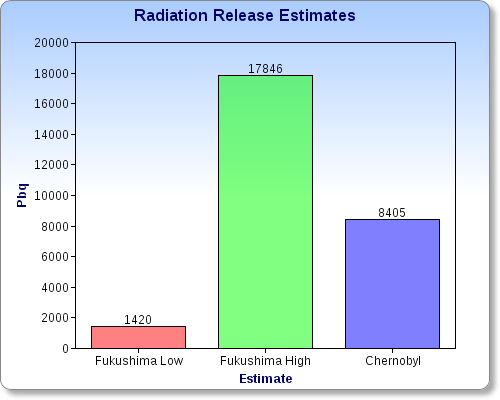
Combined Air & Sea Releases
This is one of the questions we are asked the most, “how much radiation was released from Fukushima”.
Many of the estimates out there are old initial estimates of the meltdown phase and do not include radiation releases over the years.
In our effort to answer this question we found a wide
variety of research and estimates.
With time researchers were able to
use other tools and testing to create a better idea about how much has
been released.
These estimate ranges are presented to give an idea of the
broad range of official estimates and are not a specific scientific
study. What these widely divergent estimates show is that there is a
need for more honest and accurate study of this issue.
Fukushima Vs. Chernobyl
We looked at these two disasters since they are frequently
compared to each other. The extremely high levels, all in petabecquerels
are problematic even if there is a considerable difference between the
two.
These numbers were established by using the range of
estimates that were either “all radiation” or at least included cesium
137 and iodine 131 for the initial phase of the disaster. The estimates
for the years following the accident are based on TEPCO’s admitted
hourly release rates. These totals are for the time period through
December 12, 2013
Air high: 16886 Pbq
Air low: 900 Pbq
Air low: 900 Pbq
These numbers include initial releases and also over time
releases based on oceanography institute estimates. These totals are for
the time period through December 12, 2013
Sea high: 960 Pbq
Sea low: 520 Pbq
Sea low: 520 Pbq
*does not include radiation that escaped via air but fell into the sea or that washed out to sea via rivers.
Fukushima Combined Releases To Sea & Air
Combined high: 17846 Pbq (74.5% of total inventory at the plant)
Combined low: 1420 Pbq (5.9% of total inventory at the plant)
Combined low: 1420 Pbq (5.9% of total inventory at the plant)
The release estimates provided by UNSCEAR were used for comparison.
Air: 8385 Pbq
Sea: 20 Pbq
Combined: 8405 Pbq
Air: 8385 Pbq
Sea: 20 Pbq
Combined: 8405 Pbq
NOTE: There is much more data available on this site, linked in Post Subject.
March
25, 2011 Dr Helmut Hirsh of Greenpeace Germany released a statement
that, according to analysis of radiation released to date, has
reclassified Fukushima at Level 7, comparable to Chernobyl.
April 11, 2011 TEPCO reluctantly admitted that Fukushima was now a Level 7, the worst possible. However, nobody disputes that it is multiple times worse than Chernobyl, yet there isn't any higher measurement. If TEPCO had admitted it sooner, would people have taken other precautionary measures?
The total amount of radionuclides iodine-131 and caesium-137 released since the start of the accident until March 23rd 2011 is so high that they are equal to three class 7 accidents. and it continues until stopped.
Chernobyl had one nuclear reactor and only 3 months of radiation while Fukushima has failures at four nuclear reactors which hold about 1,000 times more radiation than the bombs at Hiroshima, and 40 years of improper nuclear storage and numerous smaller nuclear events. All federal agencies that regulate radioactive exposures agree that any radiation exposure raises the cancer risk. But it isn't JUST cancer, RADIATION EXPOSURE effects your entire health profile.
Chernobyl took aggressive action after only 10 days of burning out of control. They dumped tons of sand and Boron and began entombment procedures. TEPCO worsend the nuclear disaster by adding salt water! Are they that incompetent, do they believe the laws of chemistry cease to exist in Japan, or is there something more deliberate going on? Is this really about protecting future profits?
April 11, 2011 TEPCO reluctantly admitted that Fukushima was now a Level 7, the worst possible. However, nobody disputes that it is multiple times worse than Chernobyl, yet there isn't any higher measurement. If TEPCO had admitted it sooner, would people have taken other precautionary measures?
The total amount of radionuclides iodine-131 and caesium-137 released since the start of the accident until March 23rd 2011 is so high that they are equal to three class 7 accidents. and it continues until stopped.
Chernobyl had one nuclear reactor and only 3 months of radiation while Fukushima has failures at four nuclear reactors which hold about 1,000 times more radiation than the bombs at Hiroshima, and 40 years of improper nuclear storage and numerous smaller nuclear events. All federal agencies that regulate radioactive exposures agree that any radiation exposure raises the cancer risk. But it isn't JUST cancer, RADIATION EXPOSURE effects your entire health profile.
Chernobyl took aggressive action after only 10 days of burning out of control. They dumped tons of sand and Boron and began entombment procedures. TEPCO worsend the nuclear disaster by adding salt water! Are they that incompetent, do they believe the laws of chemistry cease to exist in Japan, or is there something more deliberate going on? Is this really about protecting future profits?
You can know what radiation is in your food, soils or environment by checking with Geiger Counters and Dosimeters
Or assume, as I do, that everything is potentially contaminated and will be for thousands of years. Why not take every health precaution possible to minimize radiation effects?
Subscribe to:
Posts (Atom)