Monday, November 4, 2013


Boated Sex Poodle Still Stranded
How fortunate Mr. Gore and Generation Investment Management (GIM) were able to secure a half-page "opinion" piece in the October 30, 2013 Wall Street Journal. Readers should be grateful that GIM is so concerned for their financial well-being that they wrote this exposé of misguided investments in fossil fuels. The article reads like a self-serving stock prospectus designed to persuade potential investors sell off or short carbon assets, lest they be "stranded" with toxic investments.
Perhaps GIM would then be so kind as to take those freed funds under
its own management and redirect them to the profitable "renewables"
niche market in which they specialize.
Mr. Gore himself is stranded with the outsized and unfulfilled climate catastrophe claims of his 2006 An Inconvenient Truth. They live on in this latest anti-carbon crusade. The central claim of the WSJ article of a "consensus within the scientific community that increasing the global temperature by more than 2˚C will likely causing devastating and irreversible damage to the planet"
is unsubstantiated.
global temperature by more than 2˚C will likely causing devastating and irreversible damage to the planet"
is unsubstantiated.
Quoting a mythical consensus does not qualify as scientific truth. The inconvenient, but factual, truth is that even as atmospheric carbon dioxide has risen about 9% the past 15 years, global temperatures have remained level. Sea level rates of rise have not accelerated; no major hurricanes have stuck the U.S. since 2005.
Fossil fuels remain the mainstay of reliable energy production, here and overseas. Coal-based energy production is increasing on a worldwide basis. Germany exemplifies this trend as the energy void created by closures of their nuclear power plants is being filled by coal-fired electrical generation.
Like the iconic polar bears used to promote global warming catastrophe, Mr. Gore is now the one stranded on an Arctic ice floe of shrinking credibility.
Mr. Gore himself is stranded with the outsized and unfulfilled climate catastrophe claims of his 2006 An Inconvenient Truth. They live on in this latest anti-carbon crusade. The central claim of the WSJ article of a "consensus within the scientific community that increasing the
global temperature by more than 2˚C will likely causing devastating and irreversible damage to the planet"
is unsubstantiated. Quoting a mythical consensus does not qualify as scientific truth. The inconvenient, but factual, truth is that even as atmospheric carbon dioxide has risen about 9% the past 15 years, global temperatures have remained level. Sea level rates of rise have not accelerated; no major hurricanes have stuck the U.S. since 2005.
Fossil fuels remain the mainstay of reliable energy production, here and overseas. Coal-based energy production is increasing on a worldwide basis. Germany exemplifies this trend as the energy void created by closures of their nuclear power plants is being filled by coal-fired electrical generation.
Like the iconic polar bears used to promote global warming catastrophe, Mr. Gore is now the one stranded on an Arctic ice floe of shrinking credibility.
Thursday, October 31, 2013
35 Scientific Publications Showing Adverse Health Effects From WiFi

Waking Times
Here is an excellent collection of scientific papers finding adverse biological effects or damage to health from Wi-Fi signals, Wi-Fi-enabled devices or Wi-Fi frequencies (2.4 or 5 GHz), complied by campaign group WiFi In Schools.
The papers listed are only those where exposures were 16V/m or below. Someone using a Wi-Fi-enabled tablet computer can be exposed to electromagnetic fields up to 16V/m. Papers are in alphabetical order. A file of first pages, for printing, can be found here.
If you feel like sending a copy of this collection to the local schools in your area, you can search for them here and either print out this article to post or email the link.
Wi-Fi papers
1. Atasoy H.I. et al., 2013. Immunohistopathologic demonstration of deleterious effects on growing rat testes of radiofrequency waves emitted from conventional Wi-Fi devices. Journal of Pediatric Urology 9(2): 223-229. http://www.ncbi.nlm.nih.gov/pubmed/22465825
2. Avendaño C. et al., 2012. Use of laptop computers connected to internet through Wi-Fi decreases human sperm motility and increases sperm DNA fragmentation. Fertility and Sterility 97(1): 39-45. http://www.ncbi.nlm.nih.gov/pubmed/22112647
3. Avendaño C. et al., 2010. Laptop expositions affect motility and induce DNA fragmentation in human spermatozoa in vitro by a non-thermal effect: a preliminary report. American Society for Reproductive Medicine 66th Annual Meeting: O-249http://wifiinschools.org.uk/resources/laptops+and+sperm.pdf)
4. Aynali G. et al., 2013. Modulation of wireless (2.45 GHz)-induced oxidative toxicity in laryngotracheal mucosa of rat by melatonin. Eur Arch Otorhinolaryngol 270(5): 1695-1700.http://www.ncbi.nlm.nih.gov/pubmed/23479077
5. Gumral N. et al., 2009. Effects of selenium and L-carnitine on oxidative stress in blood of rat induced by 2.45-GHz radiation from wireless devices. Biol Trace Elem Res. 132(1-3): 153-163.http://www.ncbi.nlm.nih.gov/pubmed/19396408
6. Havas M. et al., 2010. Provocation study using heart rate variability shows microwave radiation from 2.4GHz cordless phone affects autonomic nervous system. European Journal of Oncology Library Vol. 5: 273-300. http://www.icems.eu/papers.htm?f=/c/a/2009/12/15/MNHJ1B49KH.DTL part 2.
7. Havas M. and Marrongelle J. 2013. Replication of heart rate variability provocation study with 2.45GHz cordless phone confirms original findings. Electromagn Biol Med 32(2): 253-266.https://www.ncbi.nlm.nih.gov/pubmed/23675629
8. Maganioti A. E. et al., 2010. Wi-Fi electromagnetic fields exert gender related alterations on EEG. 6th International Workshop on Biological Effects of Electromagnetic fields.http://www.istanbul.edu.tr/6internatwshopbioeffemf/cd/pdf/poster/WI-FI%20ELECTROMAGNETIC%20FIELDS%20EXERT%20GENDER.pdf
9. Margaritis L.H. et al., 2013. Drosophila oogenesis as a bio-marker responding to EMF sources.
Electromagn Biol Med., Epub ahead of print. http://www.ncbi.nlm.nih.gov/pubmed/23915130
10. Naziroğlu M. and Gumral 2009. Modulator effects of L-carnitine and selenium on wireless devices (2.45 GHz)-induced oxidative stress and electroencephalography records in brain of rat. Int J Radiat Biol. 85(8): 680-689. http://www.ncbi.nlm.nih.gov/pubmed/19637079
11. Nazıroğlu M. et al., 2012. 2.45-Gz wireless devices induce oxidative stress and proliferation through cytosolic Ca2+ influx in human leukemia cancer cells. International Journal of Radiation Biology 88(6): 449–456. http://www.ncbi.nlm.nih.gov/pubmed/22489926
12. Nazıroğlu M. et al., 2012b. Melatonin modulates wireless (2.45 GHz)-induced oxidative injury through TRPM2 and voltage gated Ca(2+) channels in brain and dorsal root ganglion in rat. Physiol Behav. 105(3): 683-92. http://www.ncbi.nlm.nih.gov/pubmed/22019785
13. Oksay T. et al., 2012. Protective effects of melatonin against oxidative injury in rat testis induced by wireless (2.45 GHz) devices. Andrologia doi: 10.1111/and.12044, Epub ahead of print.http://www.ncbi.nlm.nih.gov/pubmed/23145464
14. Papageorgiou C. C. et al., 2011. Effects of Wi-Fi signals on the p300 component of event-related potentials during an auditory hayling task. Journal of Integrative Neuroscience 10(2): 189-202. http://www.ncbi.nlm.nih.gov/pubmed/21714138 (Wi-Fi alters brain activity in young adults:http://wifiinschools.org.uk/resources/wifi+brain+July+2011.pdf)
15. Shahin S. et al., 2013. 2.45 GHz Microwave Irradiation-Induced Oxidative Stress Affects Implantation or Pregnancy in Mice, Mus musculus. Appl Biochem Biotechnol 169: 1727–1751.http://www.ncbi.nlm.nih.gov/pubmed/23334843
16. Türker Y. et al., 2011. Selenium and L-carnitine reduce oxidative stress in the heart of rat induced by 2.45-GHz radiation from wireless devices. Biol Trace Elem Res. 143(3): 1640-1650.http://www.ncbi.nlm.nih.gov/pubmed/21360060
And here are a few more studies of similar microwave frequencies at low exposures (6V/m or below) (this is not comprehensive):
17. Balmori A. 2010. Mobile phone mast effects on common frog (Rana temporaria) tadpoles: the city turned into a laboratory. Electromagn. Biol. Med. 29(1-2):31-35. http://www.ncbi.nlm.nih.gov/pubmed/20560769
18. Erdinc O. O. et al., 2003. Electromagnetic waves of 900MHz in acute pentylenetetrazole model in ontogenesis in mice. Neurol. Sci. 24:111-116 http://www.ncbi.nlm.nih.gov/pubmed/14600821
19. Fesenko E. E. et al., 1999. Stimulation of murine natural killer cells by weak electromagnetic waves in the centimeter range. Biofizika 44:737–741http://www.ncbi.nlm.nih.gov/pubmed/10544828
20. Fesenko E. E. et al., 1999. Microwaves and cellular immunity. I. Effect of whole body microwave irradiation on tumor necrosis factor production in mouse cells, Bioelectrochem. Bioenerg. 49:29–35 http://www.ncbi.nlm.nih.gov/pubmed/10619445
21. Havas M. et al., 2010. Provocation study using heart rate variability shows microwave radiation from 2.4GHz cordless phone affects autonomic nervous system. European Journal of OncologyLibrary Vol. 5: 273-300 http://www.icems.eu/papers.htm?f=/c/a/2009/12/15/MNHJ1B49KH.DTL part 2.
22. Kesari K. K. and Behari J., 2009. Microwave exposure affecting reproductive system in male rats. Appl. Biochem. Biotechnol. 162(2):416-428 http://www.ncbi.nlm.nih.gov/pubmed/19768389
23. Kesari K. K. and Behari J., 2009. Fifty-gigahertz microwave exposure effect of radiations on rat brain. Appl. Biochem. Biotechnol. 158:126-139 http://www.ncbi.nlm.nih.gov/pubmed/19089649
24. Khurana V. G. et al., 2010. Epidemiological Evidence for a Health Risk from Mobile Phone Base Stations. Int. J. Occup. Environ. Health 16:263–267http://www.ncbi.nlm.nih.gov/pubmed/20662418
25. Maier R. et al., 2004. Effects of pulsed electromagnetic fields on cognitive processes – a pilot study on pulsed field interference with cognitive regeneration. Acta Neurologica Scandinavica 110: 46-52 http://www.ncbi.nlm.nih.gov/pubmed/15180806
26. Nittby H. et al., 2008. Cognitive impairment in rats after long-term exposure to GSM-900 mobile phone radiation. Bioelectromagnetics 29: 219-232 http://www.ncbi.nlm.nih.gov/pubmed/18044737
27. Novoselova E. G. et al., 1998. Stimulation of production of tumor necrosis factor by murine macrophages when exposed in vivo and in vitro to weak electromagnetic waves in the centimeter range Bofizika 43:1132–1333.
28. Novoselova E. G. et al., 1999. Microwaves and cellular immunity. II. Immunostimulating effects of microwaves and naturally occurring antioxidant nutrients. Bioelectrochem. Bioenerg. 49:37–41http://www.ncbi.nlm.nih.gov/pubmed/10619446
29. Otitoloju A. A. et al., 2010. Preliminary study on the induction of sperm head abnormalities in mice, Mus musculus, exposed to radiofrequency radiations from Global System for Mobile Communication Base Stations. Bull. Environ. Contam. Toxicol. 84(1):51-4.http://www.ncbi.nlm.nih.gov/pubmed/19816647
30. Panagopoulos D. J.et al., 2010. Bioeffects of mobile telephony radiation in relation to its intensity or distance from the antenna. Int. J. Radiat. Biol. Vol 86(5):345-357.http://www.ncbi.nlm.nih.gov/pubmed/20397839
31. Persson B. R. R. et al., 1997. Blood-brain barrier permeability in rats exposed to electromagnetic fields used in wireless communication. Wireless Networks 3: 455-461.
32. Pyrpasopoulou A. et al., 2004. Bone morphogenic protein expression in newborn kidneys after prenatal exposure to radiofrequency radiation. Bioelectromagnetics 25:216-27http://www.ncbi.nlm.nih.gov/pubmed/15042631
33. Salford L. G. et al., 2010. Effects of microwave radiation upon the mammalian blood-brain barrier. European Journal of Oncology Library Vol. 5:333-355 http://www.icems.eu/papers.htm?f=/c/a/2009/12/15/MNHJ1B49KH.DTL part 2.
34. Salford L. G., et al., 2003. Nerve cell damage in mammalian brain after exposure to microwaves from GSM mobile phones. Environ. Health Perspect. 111:881-883.http://www.ncbi.nlm.nih.gov/pubmed/12782486
With thanks to WifiInSchools.
NOTE: Because you don't experience immediate ill effects from using WiFi, doesn't mean it isn't harming you? Headaches, irritability, brain fog?
Monsanto Buys Food Prize
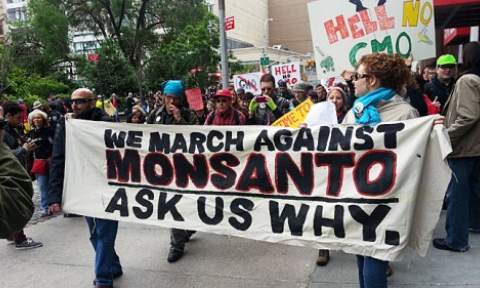
As Lily Tomlin has noted, "No matter how cynical you get, it's almost impossible to keep up."
For example, imagine if a prestigious group announced that this year's "World Environmental Prize" is being awarded to BP, for its unique contribution to the ecology of the Gulf of Mexico. No way, you say? Too absurd?
Yet, it has actually happened.
Rather than encouraging sustainable farming and self-sufficiency in impoverished communities as a way to alleviate poverty and malnutrition around the world, this year's World Food Prize has been "won" by a profiteering, biotech, seed-and-chemical monopolist that's the freakish opposite of sustainability.
Monsanto, which owns 90 percent of the world's genetically modified seeds, is globally infamous for bullying family farmers, bribing and corrupting governments, stiffing independent scientific inquiries into its hokum, running false ads and fraudulent PR campaigns, and going all out to keep consumers from knowing that the crops produced by its seeds contain alien, bioengineered DNA and have not been tested for long-term health and environmental problems.
Why would this avaricious outfit get any sort of award, much less one that can give it a false legitimacy as a corporate "savior" for the world's poor? Perhaps because Monsanto is a major funder of the World Food Prize. Indeed, the foundation that hands out the award is headquartered in downtown Des Moines in a historic building that recently got a spiffy remodeling, thanks to a $5 million donation from — you guessed it — Monsanto. The corporate honoree has also been a steady donor to the food prize foundation, giving some $400,000 to its promotion of industrial agribusiness in the last dozen years.
It was my privilege to go to Des Moines last week for Monsanto's World Food Prize extravaganza. Well, I didn't exactly get into the ceremony where the halo was being fitted on this predatory proliferator of proprietary GMO seeds. In fact, I wasn't even allowed to enter the Monsanto-financed edifice, wasn't invited to sip sauvignon blanc at the Rockefeller reception on the patio, and didn't get to mingle with the corporate, political, and foundation backscratchers at the official hullabaloo.
Rather, I was down the street at the graceful First United Methodist Church, where more than 500 of us scruffy "outsiders" gathered in protest of the Monsanto absurdity. There, real-life Iowa farmers spoke plainly about the myriad of abuses they have endured at the hands of the genetic manipulator.
One pointed out that if the corporation genuinely gave even one damn about hunger, it could've used its immense lobbying clout in Washington this year to stop Congress from stripping the entire food stamp program from the farm bill. Instead, Monsanto didn't lift a finger to help fend off hunger in our own country. It doesn't care at all about feeding the world, he said with disgust, it cares about profits, period.
Indeed, Monsanto is a pitch-perfect example of what Pope Francis was referring to in May, when he declared: "The worship of the golden calf of old has found a new and heartless image in the cult of money and the dictatorship of an economy which is faceless and lacking any truly humane goal." How ironic, then, that Monsanto bought this food prize for itself in order to masquerade as a world hunger fighter, hoping to persuade the Vatican to bless its demonic effort to force the world's poor farmers to buy and become dependent on its altered seed.
The World Food Prize Foundation has grandly dubbed its award "The Nobel Prize for Agriculture." But Monsanto has zero to do with agri-Culture. It is the agri-Business face of the cult of money that Francis warned about — and it has turned this award into the "Ignoble Prize."
Copyright Creators.com
Factory Farms :Taxpayers Pay, Politicians Take, Agribusiness Profits
 Organic Index 10.9.13
 Organic Consumers Association, October 9, 2013
For related articles and more information, please visit OCA's All About Organics page, and our Genetic Engineering page.
The agribusiness giants would have us believe that our inherently unsustainable and morally reprehensible factory farming system is the only way to feed the world’s burgeoning population. But the facts prove otherwise. Factory farming is all about maximizing profits for a handful of the world’s largest corporations.
Agribusiness spent $751 million over the past 5 years on lobbying congress and another $480.5 million in direct campaign contributions over the past two decades. Since 1995, taxpayers have provided $292.5 billion in direct agricultural subsidies, another $96 billion in crop insurance subsidies, and over $100 billion in subsidies to promote the growth of genetically engineered corn and soy.
Feeding huge numbers of confined animals actually uses more food, in the form of grains that could feed humans, than it produces. For every 100 food calories of edible crops fed to livestock, we get back just 30 calories in the form of meat and dairy. That’s a 70-percent loss. And recent research from the University of Minnesota shows that reallocating croplands away from fuels and animal feed could boost food available for people by 70 percent without clearing more land.
How did we end up with this cruel, unsustainable, unhealthy, environmentally destructive factory farm model? The numbers say it all.
The Bigger the Farm, the Larger the Taxpayer Subsidy
$292.5 billion: Total amount of taxpayer subsidies given to farms from 1995-2012.
Only $39 billion: Total amount in conservation payments paid to farms between 1995 and 2012.
10: Percentage of farms in the U.S. that collected 75 percent of farm subsidies from 1995-2012.
62: Percentage of farms in the U.S. that did not collect any subsidy payments.
$32,043: Average annual subsidies received by the largest 10 percednt of farms between 1995 and 2012.
$604: Average annual subsidy received by the smallest 80 percent of farms between 1995 and 2012.
Insuring Factory Farms at Taxpayer Expense
$15.8 billion: Cost to U.S. taxpayers in 2012 for providing crop insurance - an overwhelming majority of which went to the largest factory farms.
$96.4 billion: Cost to U.S. taxpayers for subsidizing the Crop Insurance Program from 1995-2012.
$90 billion: Cost of crop insurance to U.S. taxpayers over the next 10 years.
75: Percentage of 2012 crop insurance payouts shouldered by taxpayers.
$10.3 billion: Amount since 2001 that insurance companies have enjoyed in underwriting gains – while taxpayers have lost $276 million.
$1 million: Average amount the 26 largest factory farms collected apiece in crop insurance premium support in 2011.
$227,000: The amount the top 1 percent of policyholders received in crop insurance subsidies in 2011.
$5,000: The amount the bottom 80 percent of policyholders collected in crop insurance subsidies in 2011.
More than 10,000: Number of individual farming operations that received federal crop insurance premium subsidies ranging from $100,000 to more than $1 million apiece in 2011.
10: Percentage of farm businesses that received 54 percent of all insurance subsidies in 2011.
GMO animal feed subsidized by U.S. taxpayers
$84.4 billion: Amount in corn subsidies (88 percent of which is now genetically modified) provided in the U.S. from 1995-2012.
$27.8 billion: Amount in soy subsidies (94 percent of which is now genetically modified) provided in the U.S. from 1995-2012.
Legalized bribery: How American monopolies are built
$751 million: Amount in lobbying expenditures by the agribusiness lobby from 2008-2013.
$480.5 million: Amount the agribusiness sector has contributed to federal candidates during the past two decades, with two-thirds going to Republicans.
$43 million: Amount spent by the Biotechnology Industry Organization (world’s largest biotech trade association) on lobbying from 2008 to 2013.
$33 million: Approximate amount spent by Monsanto (who has patents on 95% of the genetically modified seed market) on lobbying since 2008.
$7.2 million: Amount just 14 members of Congress and their spouses (net worth of up to $124.5 million)—each of them Republican—have received in farm subsidies since 1995. These Congress members all voted to continue farm subsidies from which they personally benefit, while allowing authorization for nutrition programs for low income individuals and families, including food stamps, to expire this year.
Sources:
2013 Farm Subsidy Database, Environmental Working Group
Pork Barrel Politics, By Congressman George Miller, July 2013
Agribusiness, Open Secrets
Monsanto Co, Open Secrets
Biotechnology Industry Association, Open Secrets
Winning the Debate against Factory Farming
Compiled by Zack Kaldveer, assistant media director for the Organic Consumers Association.
The agribusiness giants would have us believe that our inherently unsustainable and morally reprehensible factory farming system is the only way to feed the world’s burgeoning population. But the facts prove otherwise. Factory farming is all about maximizing profits for a handful of the world’s largest corporations.
Agribusiness spent $751 million over the past 5 years on lobbying congress and another $480.5 million in direct campaign contributions over the past two decades. Since 1995, taxpayers have provided $292.5 billion in direct agricultural subsidies, another $96 billion in crop insurance subsidies, and over $100 billion in subsidies to promote the growth of genetically engineered corn and soy.
Feeding huge numbers of confined animals actually uses more food, in the form of grains that could feed humans, than it produces. For every 100 food calories of edible crops fed to livestock, we get back just 30 calories in the form of meat and dairy. That’s a 70-percent loss. And recent research from the University of Minnesota shows that reallocating croplands away from fuels and animal feed could boost food available for people by 70 percent without clearing more land.
How did we end up with this cruel, unsustainable, unhealthy, environmentally destructive factory farm model? The numbers say it all.
The Bigger the Farm, the Larger the Taxpayer Subsidy
$292.5 billion: Total amount of taxpayer subsidies given to farms from 1995-2012.
Only $39 billion: Total amount in conservation payments paid to farms between 1995 and 2012.
10: Percentage of farms in the U.S. that collected 75 percent of farm subsidies from 1995-2012.
62: Percentage of farms in the U.S. that did not collect any subsidy payments.
$32,043: Average annual subsidies received by the largest 10 percednt of farms between 1995 and 2012.
$604: Average annual subsidy received by the smallest 80 percent of farms between 1995 and 2012.
Insuring Factory Farms at Taxpayer Expense
$15.8 billion: Cost to U.S. taxpayers in 2012 for providing crop insurance - an overwhelming majority of which went to the largest factory farms.
$96.4 billion: Cost to U.S. taxpayers for subsidizing the Crop Insurance Program from 1995-2012.
$90 billion: Cost of crop insurance to U.S. taxpayers over the next 10 years.
75: Percentage of 2012 crop insurance payouts shouldered by taxpayers.
$10.3 billion: Amount since 2001 that insurance companies have enjoyed in underwriting gains – while taxpayers have lost $276 million.
$1 million: Average amount the 26 largest factory farms collected apiece in crop insurance premium support in 2011.
$227,000: The amount the top 1 percent of policyholders received in crop insurance subsidies in 2011.
$5,000: The amount the bottom 80 percent of policyholders collected in crop insurance subsidies in 2011.
More than 10,000: Number of individual farming operations that received federal crop insurance premium subsidies ranging from $100,000 to more than $1 million apiece in 2011.
10: Percentage of farm businesses that received 54 percent of all insurance subsidies in 2011.
GMO animal feed subsidized by U.S. taxpayers
$84.4 billion: Amount in corn subsidies (88 percent of which is now genetically modified) provided in the U.S. from 1995-2012.
$27.8 billion: Amount in soy subsidies (94 percent of which is now genetically modified) provided in the U.S. from 1995-2012.
Legalized bribery: How American monopolies are built
$751 million: Amount in lobbying expenditures by the agribusiness lobby from 2008-2013.
$480.5 million: Amount the agribusiness sector has contributed to federal candidates during the past two decades, with two-thirds going to Republicans.
$43 million: Amount spent by the Biotechnology Industry Organization (world’s largest biotech trade association) on lobbying from 2008 to 2013.
$33 million: Approximate amount spent by Monsanto (who has patents on 95% of the genetically modified seed market) on lobbying since 2008.
$7.2 million: Amount just 14 members of Congress and their spouses (net worth of up to $124.5 million)—each of them Republican—have received in farm subsidies since 1995. These Congress members all voted to continue farm subsidies from which they personally benefit, while allowing authorization for nutrition programs for low income individuals and families, including food stamps, to expire this year.
Sources:
2013 Farm Subsidy Database, Environmental Working Group
Pork Barrel Politics, By Congressman George Miller, July 2013
Agribusiness, Open Secrets
Monsanto Co, Open Secrets
Biotechnology Industry Association, Open Secrets
Winning the Debate against Factory Farming
Compiled by Zack Kaldveer, assistant media director for the Organic Consumers Association.
‘Groundbreaking’ Work? Or Monsanto Madness?

GAINESVILLE, Fla. — Science is trying to build a better supermarket tomato.

Tomato plants grow from genetically modified tomato leaves.
David Manning for The New York Times
Harry J. Klee and his team are identifying genes
crucial to tomato flavor. Once crucial genes are identified, Dr. Klee’s
team uses traditional techniques of cross-pollination to produce a plant
with those genes.
At a laboratory here at the University of Florida’s Institute for Plant Innovation,
researchers chop tomatoes from nearby greenhouses and plop them into
glass tubes to extract flavor compounds — the essence of tomato, so to
speak. These flavor compounds are identified and quantified by machine.
People taste and rate the hybrid tomatoes grown in the university’s
fields.
“I’m 98 percent confident we can make a tomato that tastes substantially
better,” said Harry J. Klee, a professor of horticultural sciences. He
hopes that the fruits of his labor will be available to commercial
growers within four or five years and in supermarkets a couple of years
after that. He thinks he can make seeds for better tomatoes available to
home gardeners even sooner, within a year or two.
The insipid-tomato problem is well known both to salad lovers and scientists. For example, a gene mutation
that tomato breeders love because it turns the fruit a luscious red
also happens to make it blander. Refrigeration, transportation and other
factors also take their toll. Over the decades, the average tomato has
become not only less tasty but less nutritious.
Enter Dr. Klee, who helped found the Institute for Plant Innovation a
decade ago and has been in a quest for a more flavorful and nutritious
mass-market tomato ever since.
It is easy to find a better tasting and more nutritious tomato.
Go to a
farmer’s market or grow one in the backyard. It is also easy to breed a
plant that produces something tastier than a supermarket tomato — cross a
sweet heirloom with the supermarket variety. In the greenhouse, Dr.
Klee pulls one such hybrid tomato off a vine, and it does taste sweeter.
But a hybrid also loses some of the qualities highly valued by
commercial growers — it is not as fecund, not as resistant to disease,
not as easily grown, not as pretty.
As growers are paid by the pound, a better-tasting but less productive
tomato holds little economic appeal, and thus was the supermarket tomato
doomed to blandness.
Dr. Klee’s goal is to tweak the tomato DNA — through traditional
breeding, not genetic engineering — to add desired flavors while not
compromising the traits needed for it to thrive commercially. “I figure
that with approximately five key genes we could very significantly
improve flavor,” he said. He said three genes that control the
production of key flavor compounds have already been located. The next
step is to identify versions of the genes that lead the tomato plant to
produce more of them.
The chemistry of tomato flavor has three primary components: sugars,
acids and what are known as volatile chemicals — the flavor compounds
that waft into the air carrying the fruit’s aroma. There are more than
400 volatiles in a tomato, and Dr. Klee and his collaborators set out to
first determine which ones are the most important in making a tasty
tomato.
This involved grinding up a lot of tomatoes, looking at what was in
them, and asking a lot of people to taste them (unpulverized), gathering
comments like “a bland firm watermelon,” “soft and sloppy,” and “Sweet!
Finally a sample with some sweetness.”
From there, Dr. Klee and his collaborators, who include Linda Bartoshuk, director of human research at the university’s Center for Smell and Taste,
used statistics to correlate people’s preferences with the presence, or
absence, of particular flavor compounds, to devise a chemical recipe
for the ideal tomato.
The supermarket tomato — even when grown with care and picked ripe — did
not excel. “The best it will do is middle-of-the-pack,” Dr. Klee said.
Cherry Roma tomatoes were at the top of the charts, followed by heirloom
varieties like Matina, Ailsa Craig and Bloody Butcher. Other heirlooms
like Marmande and Oaxacan Pink ranked at the bottom, below the
supermarket tomatoes, though perhaps these particular types just do not
grow well in Florida.
The taste analysis produced several surprises. Some compounds, abundant
in many tomato varieties and thus thought to be major contributors to
flavor, turned out to be irrelevant, while others, in scant quantities,
had major influences. With the new knowledge, “you can’t help but get a
better tomato,” Dr. Bartoshuk said.
The most important attribute was sweetness. The sweeter the tomato, the
higher the rating. The biggest surprise, though, was that it was not
just sugar that made a tomato sweet. Some of the flavor compounds
enhanced the perception of sweetness.
That is the key to Dr. Klee’s plans. Tomato breeders have already tried
to maximize sugar, but the plants are bred to produce a lot of big
tomatoes all at once, and then do not have energy and sunlight through
photosynthesis to make enough sugar to go around.
The sweetness-enhancing compounds, however, are present in much smaller
quantities, so getting a plant to produce more of those is a much more
achievable goal, Dr. Klee said. (The compounds also offer promise for
sweetening other foods without adding the calories of sugar.)
“His work is really groundbreaking,” said James Giovannoni, a professor of plant biology at Cornell who studies the ripening of fruit and was one of the leaders in the sequencing of the tomato genome published last year.
He said Dr. Klee has been deciphering the molecular machineries in
tomatoes that produce the flavor compounds, and that is not an easy
task. “One, there is a lot of them,” Dr. Giovannoni said, “and two, a
lot of them are really not understood, how some of these produce these
compounds hasn’t been known.”
Modern genetic engineering has provided tools to study that, and
tomatoes are one of the most common plants that plant geneticists study,
much in the same way that animal geneticists focus on mice, and now
researchers can knock out particular compounds and see if they played a
key role in flavor or not.
There has been one genetically engineered tomato in the supermarket. In
the 1980s, plant geneticists at the University of California, Davis,
just as frustrated by bland tasting tomatoes, also tried to make a
better tomato. That led to a biotechnology company, Calgene, in 1994,
developing the Flavr Savr
tomato, the first genetically engineered food of any kind in the
supermarket, its DNA tweaked to inhibit a protein that turns a tomato
mushy over time. While it sold well, Calgene foundered in the logistics
of industrial agriculture and was bought by Monsanto, which discontinued
selling the seeds.
The Florida team is not repeating the Flavr Savr game plan.
Although Dr. Klee experiments with genetically engineered tomatoes to
test and confirm findings, he said that none of the ones eventually
destined for supermarkets will be — partly to avoid potential consumer
backlash and partly because his university cannot afford the estimated
$15 million that would be needed to obtain regulatory approval to sell a
genetically engineered tomato.
Instead, the tomato would be created through traditional breeding
techniques, but using genetic tests to determine which of the plants
possess the desired genes.
The quest for year-round produce at the supermarket has also led to
tomatoes being grown in less-than-ideal places — like Florida, where the
soil is too sandy and there are plenty of pests — when the traditional
tomato-growing areas farther north are too chilly.
Dr. Klee does not expect the improved tomato to taste as good as the
best heirlooms. Supermarket tomatoes would still be grown in large
quantities, picked green and shipped long distances before being gassed
with ethylene to ripen. In addition, the tomatoes are often mishandled
en route. Refrigeration, Dr. Klee notes, destroys the flavor compounds
in even the best tomato. “I might be able to get 75 percent” of the best
tomato in one that can be grown in greater quantities, he said.
Some traditional breeders are skeptical that Dr. Klee can do what he
thinks he can as quickly as he predicts. “I don’t think the taste of
tomatoes is going to be fixed by molecular biologists,” said David Francis,
a professor at The Ohio State University who has bred and released
several tomato varieties, “because flavor is a lot more complicated than
manipulating one or two genes.”
After working with tomatoes for so long, Dr. Klee admits he does not eat
many of them, but he does want the public to be able to buy appetizing
ones. Part of his quest is to get people to eat less junk food. If he
can improve the taste of tomatoes, he said, it could be an important way
to coax Americans to eat healthier foods.
Tomatoes aren’t the only focus of the Institute for Plant Innovation.
Researchers are working on a more fragrant rose, a project that involves
the genetic engineering feat of inserting — yes — a tomato gene in a
rose plant. They are also trying to grow tastier strawberries and
blueberries. One new blueberry variety could be described as positively
crispy, almost apple-like in its texture.
Consumers who tasted these blueberries liked their firmness, and the
quality is also a boon to growers, because the fruit lasts longer.
“It’s a blueprint,” Dr. Klee said of his tomato quest, “for a much bigger program of bringing back flavor.”
Why Dr. Bronner's is on a Soapbox for GMO Labeling~ The Fighting Soap Company!
On November 5, citizens in Washington State will vote on whether to require mandatory labeling of genetically engineered foods, also known as genetically modified organisms or GMOs. Win or lose, The Washington Right to Know Genetically Engineered Food Act is driving the national push on GMO labeling in states around the country as well as at the federal level—just as the narrowly defeated Prop 37 in California did last year.
Contrary to the misleading rhetoric and propaganda espoused by chemical companies like Monsanto and Dow that portrays GMO labeling on food packaging as costly and unnecessary, the truth is we have the right to know important information about our food, and such disclosures on packaging cost virtually nothing. We have the right to know whether juice is from concentrate or not; whether ingredients are artificial or not; whether fish is farmed or wild-caught. We also have the right to know if food is genetically engineered, in order to make informed decisions about what we eat and feed our families.
Chemical companies genetically engineer DNA from bacteria into food crops, causing the crops to either produce or tolerate the pesticides they sell. Overuse of pesticide is creating resistant superweeds and superbugs, which leads to more pesticides being sprayed. Now, chemical companies like Monsanto and Dow are engineering resistance in food crops to increasingly toxic weed killers like Dicamba and 2,4-D, the main ingredient in Agent Orange (which, coincidentally, both Monsanto and Dow also manufactured).
The bottom line is that genetic engineering of food crops is a pesticide industry boondoggle. Just six chemical companies have bought and now control the seed industry in this country, and their interest is to increase—not reduce—agchemical inputs. Rather than help farmers move toward more sustainable and less chemical intensive agriculture, genetic engineering has resulted in huge increases in pesticide use and residues of these chemicals in our food. Pesticide Action Network is a great resource on the link between GMOs and pesticides, and the next generation weed killer tolerant crops in the regulatory pipeline. Even the Wall Street Journal has reported on the recent spike in insecticide use.
Just this past week came news about Argentina's pesticide use and reported cancer clusters. In question: the huge increase in pesticide use—and consequential health impacts—since the widespread adoption of genetically engineered crops in Argentina. It's important to understand that no currently commercialized GMO traits, or any in the regulatory pipeline, have the effect of boosting yield to "feed the world." Rather, by far the most important in terms of acreage and revenue are traits designed to increase weed killer tolerance and the short-term profits of the chemical industry.
Additionally, of the five major crops that have been genetically engineered so far (corn, soy, cotton, canola and sugar beets), corn and soy are by far the most prevalent, as the number one and two crops farmed in the U.S. However, these crops are mostly not grown for human consumption.
Big Ag lobbies for and profits from unsustainable ethanol fuel mandates that result in 43 percent of total corn acreage going into inefficient ethanol production from GMO corn kernels (not cellulosic waste straw). Most of the remaining corn production, and much of the U.S. GMO soy crop, goes into animal feed. Industrial agchemical farming of GMO crops for fuel and animal feed only exacerbates world hunger. Study after study shows that agroecological organic methods of agriculture in the developing world can feed the world's population twice over while significantly boosting rural development (see the UN Report, "Agroecology and the Right to Food").
Industrial agchemical agriculture relies on finite fossil resources, is a huge contributor to global climate change, and is inevitably doomed. But there are billions to be made in the meantime polluting the world and killing our soil. Since agroecological methods are knowledge-intensive and are not patentable or profitable for Big Ag, chemical corporations spend millions to ensure national policy reinforces their chemical intensive and genetically patentable—but ultimately unsustainable—business model.
Last year, Dr. Bronner’s Magic Soaps joined a diverse, grassroots coalition of consumer groups, health advocates, and environmentalists in California in support of Proposition 37. Pesticide and junk food manufacturers spent more than $44 million to narrowly defeat the initiative with deceptive advertising. Despite its defeat, Proposition 37 sparked a national movement for the right to know whether foods contain GMOs, with states around the country considering or enacting legislation to do so. Connecticut and Maine have already passed GMO labeling laws, which, as stipulated in the legislation, will go into effect when at least five more New England states also pass such laws. Washington State is the next battleground with major agricultural sectors concerned that unlabeled genetically engineered wheat, apples, and salmon will compromise consumer trust in these foods.
To help spread the word about the importance of GMO labeling, we have transformed our iconic Dr. Bronner's Magic Soaps label for the castile liquid soaps into an advocacy label, to garner support for the Yes on 522 campaign to label GMOs in Washington, and to raise awareness for the importance of transparency in food labeling. For a limited time, wherever you buy Dr. Bronner's quart castile soaps, you'll find this GMO-Info label on the quart size bottles, and we hope you'll take a moment in the shower to read it.
As the "fighting soap company," we seek to push for a number of social issues that we feel are good. All our soaps are certified under the same USDA National Organic Program that certifies food, and all major ingredients (coconut, olive, palm, hemp and mint oils) are also certified Fair Trade. We cap executive compensation at five to one per our lowest paid position, and dedicate profits not needed for the business to charitable and activist causes.
We have prioritized labeling of genetically modified foods alongside supporting at-risk youth programs, re-commercializing industrial hemp, animal advocacy, fairness in trade, and other worthwhile efforts. My brother and I wrote this new GMO info label in the tradition of our grandfather, Dr. Emanuel Bronner, and his "All-One" philosophy, and on behalf of our commitment to healthy and sustainable agriculture, corporate accountability, and the consumers' right to know—all of which embody the social and ecological principles that inform the philosophy printed on the original castile liquid soap labels.
Whether you live in Washington, or elsewhere in the U.S., this is a food fight that affects all of us. Learn more about the GMO issue, support the Yes on 522 campaign in Washington, and join the growing movement to demand mandatory GMO labeling in your state and at the federal level.
Look Who's Spending Millions to Defeat GMO Labeling in Washington
The opposition: WA I-522 Vote No Funders
Hover over a slice of the pie graph for details:*The Grocery Manufacturers Association includes these Companies: Safeway (O Organics), Starbucks, Target, Con-Agra (Alexia, Hunt's Organic and Natural Brands, Lightlife, Orville Redenbacher's Organic), Kellogg's (Kashi, Bear Naked, Gardenburger, Morningstar Farms), Unilever (Ben & Jerry's), Kraft (Boca Burgers), General Mills (Cascadian Farm, Larabar, Muir Glen), Hershey's (Dagoba,) Coca-Cola (Honest Tea, Odwalla), Dean Foods (Horizon Organic, Silk, White Wave), Pepsico (Naked Juice, Tostito's Organic, Tropicana Organic), Smucker's (R.W. Knudsen)
NOTE:
The
funny thing is, voting yes could work out to Monsanto's et al benefit.
They'll jump on board, saying "we're proud that this food contains GE
ingredients, which feed the world" or some other garbage.
Cigarette
warning labels didn't stop smoking, while I support GMO labels,
informed consumers already know. Uninformed consumers prefer
ignorance. Maybe some uninformed will take the time to read labels,
although that is insufficient knowledge.
Many "organic" trash foods
contain GMO, such as sugar (sugar beets) Canola oil etc....they just see
the word organic and don't pursue the ingredients any further. Plus
"natural" already allows HFCS etc....
We really live in a corporate ruled society where deception is critical for bottom lines.
People already have more power than the voting both, more power than any legislation. Just vote with each $$$ that they spend.
Monday, October 28, 2013
Will All The Kings Horses Harrass Portland Homeless?
To: Michael Oswald
Kim Peoples, Director of Community Services
To: Multnomah County Commission
To: Multnomah County Commission
See
below: so often addressed. Any one with any current knowledge and
common sense knows that fines punishment and extorted surrender
accomplish nothing in animal enforcement ( the most insignificant of
crimes) although sometimes they have an effect by frightening citizens,
especially the vulnerable and poverty stricken into surrendering their
animals when humane alternatives exist.
At MCAS,
however failure and bad policy are no reason to reconsider. The lack of
government performance standards at the county commission and this
agency is astonishing for an urban community; a complete squandering of
tax payer resources without accountability, best suited to a private
club not public office.
Additional ticket examples in part one:
NOI 90107
a $300 fine issued for a first offense minor bite to Mary Mackrill,
homeless, an accident, with the requirement that her dog must wear a
muzzle at all times except when eating or drinking or in extreme heat.
What is extreme heat, Mr. Oswald ( What most of us feel when impossible
conditions are issued) ?. Or her dog will be surrendered.
.These are my questions:
How is a $300 fine a deterrent
to someone who is homeless and has no money? Of course you will send
this to collections so you can ruin a poverty stricken homeless person's
"credit". Exactly what have you accomplished?
We can't offer legal help because only you have a way to contact Ms.Mackrill.
The
imposed conditions of constant muzzling except for extreme heat ( What
is that: 85 degrees; 95? What is the measure?. Should the homeless
person carry a thermometer? ) amount to animal cruelty and is an
impossible compliance requirement, just as impossible as the oft cited
requirement of homeless persons that they build a secure concrete based
enclosure on property they don't have because they don't have a home.
Why
don't you permit an owner education diversion class that teaches new
skills instead of futilely punishing those with challenges who have no
skills? Other places have "Street Smarts for the Street Dog". This
intervention, so successful elsewhere, falls on deaf ears because you
have fixed ideas and failed polcies and refuse to budge.
NOI 89562 to
Joseph Razzouk, a UPS driver, who realy loves his dog. His dog gets
out. Help him instead of issuing a $500 fine making any solution
impossible.
There
are other tickets just like this one, equally thoughtless, and I will
just begin posting them every week so the public can know where its
taxes go.
If
you will not honor this community's values and direction,
please resign. A community government agency on auto pilot needs a new
leader. All the King's horses and All the King's men can't fix this when
no effort is made and leadership just doesn't care.
Gail O'Connell-Babcock
503.625.4563,
Subscribe to:
Posts (Atom)