Tuesday, December 3, 2013


Almost 1000 record low max temps vs 17 record high temps


Records in the last 7 days:
205 snowfall records.
969 Low Max. 203 Low temps.
17 High Temp.
61 High minimum.
Yes, those are snowfall records in Texas. And yes, it is still Fall.
http://wx.hamweather.com/maps/climate/records/1week/us.html?cat=maxtemp,mintemp,snow,lowma x,highmin,
Will Bail Ins Be Next For Depositors Money?
Ellen Brown, founder of WebofDebt.com, thinks so-called 'bail-ins' are coming. Depositors' money will be legally taken. Brown says, "That's the big disaster that's coming.
Probably one of these big derivative banks will go bankrupt . . . the derivative players will get first dibs.
They'll grab all the deposits, and there won't be anything left."
Join Greg Hunter as he goes One-on-One with author and journalist Ellen Brown.
Monday, December 2, 2013
Study finds giant strontium-90 release into body of water begins around 1,000 days after meltdown — Dec. 5, 2013 = thousand days after 3/11 — Graphic shows very high levels being discharged for up to 50,000 days
Background information on Fukushima
Arjun Makhijani, nuclear expert and President of the Institute for Energy and Environmental Research: Ground water is contacting the molten fuel and becoming extremely contaminated [...] The fuel is molten and the bottom of the reactor building is undoubtedly damaged. So that’s why the ground water flowing past the trenches and pipes and past the basement of the reactor building is getting into the reactor building where the molten fuel is. It may also be that the molten fuel is in the cracks of the foundation.
Associated Press: The turbine buildings at the Fukushima Dai-ichi plant are about 150 meters (500 feet) from the ocean. According to a Japan Atomic Energy Agency document, the contaminated underground water is spreading toward the sea at a rate of about 4 meters (13 feet) a month. At that rate, “the water from that area is just about to reach the coast,” if it hasn’t already, said Atsunao Marui, an underground water expert [...] on a government committee studying the contaminated water problem. “We must contain the problem as quickly as possible.”
German study from early 1990s parallels situation at Fukushima

International Radiation Protection Association,
1992: “After a core meltdown accident it cannot be completely ruled out
that the melt will reach, and partly penetrate, the concrete
foundation. The amounts of some radionuclides leached out by the passing
groundwater are estimated. The transport of dissolved radionuclides in
groundwater is simulated by an analytical dispersion model [...] a core
meltdown accident could well cause the melt to penetrate into the
reactor foundation and pass through it down to the bottom side of the
foundation within five days.
Even if the passing groundwater were to prevent complete melt-through, there would still be a direct contact of the groundwater with the re-solidified melt surface through fissures, cracks, etc., which could cause the fission products to be leached. [...] Figure 1a shows the concentration in the groundwater and in the river water 500 m away from the reactor between 100 days and 100,000 days . The groundwater was assumed to be discharged into the river water 500 m from the reactor [...] The highest radionuclide concentration of approx. 10^10 Bq/m3 [10 billion Bq/m3] is reached by Sr-90 after some 5,000 days.”
According to Figure 1a, strontium-90 levels stay near zero for the first 1,000 days, after which levels spike to dramatically and appear to remain elevated for the next 50,000 or so days. Though Fukushima is more than 3X closer to the water than the reactor in this study, it is more than 3X slower (0.133 meters/day vs. 0.5 m/d). And of course, Fukushima is dealing with three melted reactor cores, not one.
So when will it be 10^3 [or 1,000] days after 3/11? December 5, 2013, which is this Thursday.
Regarding strontium-90, marine chemist Ken Buesseler from Woods Hole Oceanographic Institution said, “Our biggest concern right now is if some of the other isotopes such as strontium 90 which tend to be more mobile, get through these sediments in the ground water [...] They are entering the oceans at levels that then will accumulate in seafood and will cause new health concerns.”
The study lists several ways to try and mitigate the contamination: Installing impermeable walls around the plant, pumping off the groundwater, using extraction pumps, and freezing the soil.
However, Buesseler said, “Any contamination in the groundwater would eventually flow into the ocean. That is very difficult to stop even with barriers.” The AP writes that Buesseler’s research suggests “contaminated water from the reactor-turbine areas is already leaking into the sea.”
Arjun Makhijani, nuclear expert and President of the Institute for Energy and Environmental Research: Ground water is contacting the molten fuel and becoming extremely contaminated [...] The fuel is molten and the bottom of the reactor building is undoubtedly damaged. So that’s why the ground water flowing past the trenches and pipes and past the basement of the reactor building is getting into the reactor building where the molten fuel is. It may also be that the molten fuel is in the cracks of the foundation.
Associated Press: The turbine buildings at the Fukushima Dai-ichi plant are about 150 meters (500 feet) from the ocean. According to a Japan Atomic Energy Agency document, the contaminated underground water is spreading toward the sea at a rate of about 4 meters (13 feet) a month. At that rate, “the water from that area is just about to reach the coast,” if it hasn’t already, said Atsunao Marui, an underground water expert [...] on a government committee studying the contaminated water problem. “We must contain the problem as quickly as possible.”
German study from early 1990s parallels situation at Fukushima
Figure
1a: Radionuclide concentrations in groundwater and river water — X axis
represents days since the initial meltdown (10^3 = 1,000 days; 10^4 =
10,000 days; 10^5 = 100,000 days)
Even if the passing groundwater were to prevent complete melt-through, there would still be a direct contact of the groundwater with the re-solidified melt surface through fissures, cracks, etc., which could cause the fission products to be leached. [...] Figure 1a shows the concentration in the groundwater and in the river water 500 m away from the reactor between 100 days and 100,000 days . The groundwater was assumed to be discharged into the river water 500 m from the reactor [...] The highest radionuclide concentration of approx. 10^10 Bq/m3 [10 billion Bq/m3] is reached by Sr-90 after some 5,000 days.”
According to Figure 1a, strontium-90 levels stay near zero for the first 1,000 days, after which levels spike to dramatically and appear to remain elevated for the next 50,000 or so days. Though Fukushima is more than 3X closer to the water than the reactor in this study, it is more than 3X slower (0.133 meters/day vs. 0.5 m/d). And of course, Fukushima is dealing with three melted reactor cores, not one.
So when will it be 10^3 [or 1,000] days after 3/11? December 5, 2013, which is this Thursday.
Regarding strontium-90, marine chemist Ken Buesseler from Woods Hole Oceanographic Institution said, “Our biggest concern right now is if some of the other isotopes such as strontium 90 which tend to be more mobile, get through these sediments in the ground water [...] They are entering the oceans at levels that then will accumulate in seafood and will cause new health concerns.”
The study lists several ways to try and mitigate the contamination: Installing impermeable walls around the plant, pumping off the groundwater, using extraction pumps, and freezing the soil.
However, Buesseler said, “Any contamination in the groundwater would eventually flow into the ocean. That is very difficult to stop even with barriers.” The AP writes that Buesseler’s research suggests “contaminated water from the reactor-turbine areas is already leaking into the sea.”
Dead/Dying Sea Stars In West Seattle Video
Dead/Dying seastars in West Seattle (with opening footage to show same site last year) from Laura James on Vimeo.
Please report on the starfish you see on dives... (and on the beach)
Upload a picture of the beach (topside) where you saw sick stars to instagram with the hashtag #sickstarfish This will put it on a map we are putting together. You will need to make sure geolocation is "on" and you are uploading from the site (not from your house). We are also working on a manual add for the site, but that is not up and running yet.
If you dive at a site that has no sick seastars please upload #nosickseastars that way we can get a baseline as well, and actually see spread over time. Tidepool walkers are also encouraged to become involved as the purple starfish are often visible on low tides and you will be able to see melting sea stars.
This is where data will be showing up in real time at sickstarfish.com
Enter more data at the University of Southern California's page.
eeb.ucsc.edu/pacificrockyintertidal/data-products/sea-star-wasting/index.html
Site: Cove 1, Seacrest, West Seattle, Washington State.
Video: Laura James Dive Buddy: Jan Shaw
Camera: 5DMK2 Housing: Subal Lights: Light & Motion SOLA 2000 X 2
Sunday, December 1, 2013
Pet Owners Increasingly Using Medical Cannabis To Help Pets
NaturalNews) As the social stigmas and taboos about marijuana that
largely emerged during the "Reefer Madness" generation continue to be
stripped away from the public consciousness, an increasing number of
people are beginning to look at this all natural herb with fresh eyes,
recognizing its incredible potential for healing. This includes a
growing number of pet owners who are now using the plant and its
essential oils to safely and effectively treat their ailing pets.
CBS New York reports that veterinary cannabis use is on the rise across all segments of society, and particularly among pet owners whose pets have severe or even terminal illnesses that do not respond to conventional treatment. Major conditions like cancer, many pet owners are finding, respond quite well to cannabis use when nothing else does. And unlike conventional treatments, cannabis treatment does not cause any harmful side effects.
One such success story is "Luna" Capers, the beloved dog of Rowyn Capers who reportedly gained her quality of life back after being given a non-psychoactive cannabis oil extract for late-stage lymphoma. When chemotherapy left the dog gravely ill and on the verge of death, Rowyn began to administer the natural therapy instead, which produced incredible results.
"Her lymph nodes were like golf balls and she was coughing constantly and she couldn't breathe, and I just thought it's time to say goodbye," said Rowyn to CBS News about Luna's condition before the cannabis. "The first time I dosed her [with cannabis] I was so scared. We were looking at her all night. [But the] more I increased her cannabis dose the less side effects that she had. The vomiting stopped, the diarrhea stopped."
Similar success was achieved by Mary Lynn Mathre, the owner of a 13-year-old golden retriever who was also diagnosed with cancer. After learning about cannabis, Mary Lynn began to give all of her dogs a daily cracker topped with cannabis-infused butter, which not only helped the sick one but also helped improve the health of all her dogs, including one with a strange bald spot on its leg.
"There was no hair on a circle that it would lick and lick," stated Mary Lynn to CBS New York, noting that both dogs experienced dramatic improvements as a result of the cannabis.
"When you see them enjoying life and feeling better and not being sick, you know you've hit something," says Darlene Arden, a certified animal behaviorist who is a strong advocate for veterinary cannabis use. "I think we can now see marijuana for exactly what it is and what it can do. [It's not] a street drug but a legitimate medication to be used under proper supervision."
Many CBS New York commenters with pets seem to agree with these sentiments, as some of them posted their own stories about how medical cannabis helped their pets. One woman recounts how her three-year-old dog almost died from epilepsy but experienced a dramatic and immediate recovery after being placed on a regimen of medical cannabis.
"As a last ditch effort after her last bout of seizures and being unable to come out of her postictal state, despite being administered a heavy sedative by our vet, we tried marijuana we had received from a friend of ours (it's legal in our state)," writes the commenter. "Within less than 15 minutes, our dog came fully out of its postictal state, laid down, and napped for (about) 2 hours before waking up and wanting to play tennis ball and tug. It was beyond anything I had seen before with this dog."
CBS New York reports that veterinary cannabis use is on the rise across all segments of society, and particularly among pet owners whose pets have severe or even terminal illnesses that do not respond to conventional treatment. Major conditions like cancer, many pet owners are finding, respond quite well to cannabis use when nothing else does. And unlike conventional treatments, cannabis treatment does not cause any harmful side effects.
One such success story is "Luna" Capers, the beloved dog of Rowyn Capers who reportedly gained her quality of life back after being given a non-psychoactive cannabis oil extract for late-stage lymphoma. When chemotherapy left the dog gravely ill and on the verge of death, Rowyn began to administer the natural therapy instead, which produced incredible results.
"Her lymph nodes were like golf balls and she was coughing constantly and she couldn't breathe, and I just thought it's time to say goodbye," said Rowyn to CBS News about Luna's condition before the cannabis. "The first time I dosed her [with cannabis] I was so scared. We were looking at her all night. [But the] more I increased her cannabis dose the less side effects that she had. The vomiting stopped, the diarrhea stopped."
Similar success was achieved by Mary Lynn Mathre, the owner of a 13-year-old golden retriever who was also diagnosed with cancer. After learning about cannabis, Mary Lynn began to give all of her dogs a daily cracker topped with cannabis-infused butter, which not only helped the sick one but also helped improve the health of all her dogs, including one with a strange bald spot on its leg.
"There was no hair on a circle that it would lick and lick," stated Mary Lynn to CBS New York, noting that both dogs experienced dramatic improvements as a result of the cannabis.
Cannabis helps pets with low energy, cancer, and epilepsy
Al Byrne's three dogs, who range in age from three to 13, have also responded positively to marijuana. Besides noticeable increases in energy among all the dogs, Al says each of his furry family members now has a shinier coat and a "shine in their eyes" that was not there before."When you see them enjoying life and feeling better and not being sick, you know you've hit something," says Darlene Arden, a certified animal behaviorist who is a strong advocate for veterinary cannabis use. "I think we can now see marijuana for exactly what it is and what it can do. [It's not] a street drug but a legitimate medication to be used under proper supervision."
Many CBS New York commenters with pets seem to agree with these sentiments, as some of them posted their own stories about how medical cannabis helped their pets. One woman recounts how her three-year-old dog almost died from epilepsy but experienced a dramatic and immediate recovery after being placed on a regimen of medical cannabis.
"As a last ditch effort after her last bout of seizures and being unable to come out of her postictal state, despite being administered a heavy sedative by our vet, we tried marijuana we had received from a friend of ours (it's legal in our state)," writes the commenter. "Within less than 15 minutes, our dog came fully out of its postictal state, laid down, and napped for (about) 2 hours before waking up and wanting to play tennis ball and tug. It was beyond anything I had seen before with this dog."
Saturday, November 30, 2013
HSUS’s Ongoing War Against Animal Agriculture Suffers Another Significant Loss:
“Pork, The Other White Meat” Lawsuit
WASHINGTON, D.C., Sept. 26, 2013 – After spending significant amounts of donor dollars, the Humane Society of the United States (HSUS) was dealt a significant loss in U.S. District Court on Wednesday. In what was considered to be a futile legal challenge and a very personal attack on U.S. pork producers, a U.S. district judge Wednesday dismissed a lawsuit filed by HSUS over the National Pork Board’s purchase of the “Pork, The Other White Meat” trademark from the National Pork Producers Council (NPPC).HSUS, which was joined in the suit by a lone Iowa pork producer and the Iowa Citizens for Community Improvement, sued the U.S. Department of Agriculture (USDA) – and Secretary Tom Vilsack – over approval of the trademark purchase and the Pork Board’s annual payments to NPPC. HSUS argued that the sale and payments were unlawful since the Pork Board is prohibited from using checkoff dollars to influence legislation.
The court dismissed the HSUS case, ruling that the plaintiffs lacked standing and that no one had suffered any injury from the Agriculture Secretary’s actions.
NPPC applauded the Secretary’s willingness to defend the case and pork producers across this country. The Secretary’s actions should send a strong signal to HSUS supporters that frivolous lawsuits will not be tolerated and should not be pursued.
“If I were a donor to HSUS, I would be very disturbed that my money was wasted on yet another expensive lawsuit that had nothing to do with improving the welfare of farm animals,” said NPPC President Randy Spronk, a pork producer from Edgerton, Minn.
“This is clearly a vendetta against the U.S. pork industry by the leadership of HSUS, which has made their mission to permanently end animal agriculture very clear. It was frivolous and a waste of the taxpayers’ money and the court’s time. HSUS donors deserve better than that.”
For more information regarding the case of HUMANE SOCIETY OF THE UNITED STATES et al v. VILSACK, click her
Tuesday, November 26, 2013
Unprecedented concentration of sea creatures near shore in California; escaping radiation?

MONTEREY, Calif. — It began with the anchovies, miles and miles of them, their silvery blue bodies thick in the waters of Monterey Bay.
Large numbers of whales have congregated off Monterey
Bay to the delight of camera-wielding whale watchers like the ones
aboard Nancy Black’s Sea Wolf II.

Sea lions have also been attracted by an enormous late bloom of anchovies.

Jim Wilson/The New York Times
Guests on the Sea Wolf II examined a piece of the filter system in a whale’s mouth.
Then the sea lions came, by the thousands, from up and down the
California coast, and the pelicans, arriving in one long V-formation
after another. Fleets of bottlenose dolphins joined them.
But it was the whales that astounded even longtime residents — more than
200 humpbacks lunging, breaching, blowing and tail flapping — and, on a
recent weekend, a pod of 19 rowdy orcas that briefly crashed the party,
picking off sea lions along the way.
“I can’t tell you where to look,” Nancy Black, a marine biologist
leading a boat full of whale watchers last week, said as the water in
every direction roiled with mammals. “It’s all around.”
For almost three months, Monterey and nearby coastal areas have played
host to a mammoth convocation of sea life that scientists here say is
unprecedented in their memories, inviting comparisons to African scenes
like the wildebeest migration or herds of antelope on the Serengeti.
Humpback whales, pelicans and sea lions are all common summer sights off
the Monterey coast, with its nutrient-rich waters. But never that
anyone remembers have there been this many or have they stayed so long,
feeding well into November.
“It’s a very strange year,” said Baldo Marinovic, a research biologist with the Institute for Marine Sciences at the University of California, Santa Cruz.
What has drawn the animals is a late bloom of anchovies so enormous that
continuous, dense blankets of the diminutive fish are visible on depth
sounders. The sea lions, sea birds and humpbacks (which eat an average
of two tons of fish a day) appear to have hardly made a dent in the
population. Last month, so many anchovies crowded into Santa Cruz harbor
that the oxygen ran out, leading to a major die-off.
Marine researchers are baffled about the reason for the anchovy explosion.
“The $64,000 question is why this year?” said Dr. Marinovic, who noted
that anchovies had been unusually scarce for the last five or six years
and that when they do thrive, they usually appear in the spring and
early summer.
He and other scientists speculated that a convergence of factors — a
milder than usual fall, a strong upwelling of colder water, the cycling
of water temperatures in the bay — have created what Dr. Marinovic
called “the perfect storm.”
“Now they’re all kind of concentrating on the coast,” he said of the
anchovies. “They seem to seek out Monterey Bay because the water tends
to be a little warmer and the eggs will develop quickly.” The fish, he
said, “are providing a feast for all these things that feed on them.”
The frenzy has been a boon for whale-watching companies like Monterey Bay Whale Watch, of which Ms. Black is the owner, and for their customers.
In a normal season, passengers are lucky to see one or two humpbacks and
a single whale breaching. On the trip last week, more than 60 whales
were spotted feeding in the deep water of the canyon offshore, and the
breaches were almost too numerous to count — in one case, two whales
arced their bodies out of the water in unison, like competitors in an
Olympic synchronized swimming event.
Foul-smelling whale breath
occasionally permeated the air. Ms. Black said that for the first time this year — she has studied
whales here since 1986, specializing in orcas — she has seen evidence
that the humpbacks are feeding cooperatively with groups of thousands of
sea lions.
The sea lions dive simultaneously, surfacing a few minutes
later. They herd the anchovies into tight balls, called bait balls, and
the whales scoop them up, several hundred in a mouthful. Food is
plentiful enough that the giant cetaceans — an adult male humpback
measures 45 to 50 feet in length, Ms. Black said, and weighs a ton per
foot — can afford to take breaks to play.
The humpback population off the California coast, once rapidly
decreasing, has rebounded with restrictions on hunting, to about 2,000,
experts say. Many whales and sea lions have been congregating to feed
near the rim of the Monterey Submarine Canyon offshore. Bottlenose
dolphins — groups of 100 or more have been spotted this year — feed
closer in.
In most years, the humpbacks would have departed for Mexico weeks ago
and the pelicans flown south. But with the anchovies still in abundance,
no one is sure how long they will stay. They could remain through
December, scientists said, or depart any day.
“I hope it doesn’t end,” Ms. Black said. “But it will.”
Fukushiima Radiation Headed Toward SoCal Beaches
Not a lot of good news has been coming out of Japan lately. This week
at the United Nations COP 19 climate talks meeting in Warsaw it was
announced that Japan will renege on its carbon emissions pledge.
This means that instead of lowering its emissions of greenhouse gases
by 2020 its emissions will actually increase based on 1990 levels. The
reason Japanese officials give is because of the shutdown of its fifty
nuclear power plants, which will mean more reliance on fossil fuels to
meet its energy needs.
Of course, the shutting down of the nuke plants is not a bad thing, especially in light of the Fukushima disaster which until very recently seems to have been suffering from a bit of a news blackout by the mainstream corporate media. This is especially troubling given the imminent passage of a new censorship law in Japan that could make reporting news about Fukushima a crime in the name of protecting state’s secrets (gee, sound familiar?).
How much you know about the situation on the ground at the crippled Daiichi plant depends on how much you are intentionally seeking the information. Many people I talk to still don’t seem to fully comprehend the scope of the problem, likely because it hasn’t dominated the evening news. There is a lot to know but the most troubling facts are
1), that 300 tons of radioactive water have been spilling into the Pacific Ocean every day and is seeping into the groundwater; 2) the clean-up process is so risky that it continues to be delayed and has been called the world’s It’s also been called “the potentially the biggest ticking time bomb in human history.”
The crisis is obviously bad enough for the Japanese, but what keeps me awake at night is the radioactive plume making its way across the Pacific. It worries me because I live in a Southern California beach community, and as surfers committed to a healthy lifestyle, my family and I spend a lot of time in the ocean. I think also of the many Native nations in the US and Canada whose ancient ways of life depend on the “big waters” of the Pacific and this is just the newest threat to those ways.
Perceptions of the seriousness of the radioactive plume (to say nothing of the radiation being released into the atmosphere) seem to, not surprisingly, run along ideological lines between those who support nuclear energy and those who don’t. On the anti-nuclear side, high profile experts such as Helen Caldicott and David Suzuki mince no words about the danger it poses, especially to the North American west coast, to say nothing of all the life in the ocean. Other more conservative industry experts tend to downplay the seriousness of the radioactive plume, saying the ocean will dilute the radioactive particles to negligible levels. Naturally, they are critical of the anti-nuke voices.
The proliferation of nuclear energy is a symptom of the insanity of Western-based modern science. It is reflective of a people who have so little respect for life that they are willing to sacrifice their own grandchildren’s generation to satisfy today’s desires for wealth, all in the name of progress and the betterment of humanity.
That is what happens when you deem acceptable a technology that produces a waste byproduct so toxic and dangerous that not only is it impossible dispose of safely, but it remains life threatening for tens of thousands of years.
Although Japan was victimized by America's use of nuclear weapons at Hiroshima and Nagasaki, it has fully embraced the values and technology of Western (i.e. Euro-American) culture. But in Fukushima’s wake a growing chorus of Japanese intellectuals is denouncing Japan’s attachment to nuclear power. Professor Mitsui Murata, former Japanese Ambassador to Switzerland, said in a video widely circulating the internet that “the Japanese people realize from experience that nuclear energy generates unacceptable calamities…Japan must assume the historic role of promoting denuclearization, both civilian and military.”
In another fascinating documentary which highlights two of Japan’s top philosophers, Fukushima is characterized by the renowned Takeshi Umehara as a “civilization disaster,” because “civilization” as we know it is based on Western philosophic ideas. “Humanity cannot survive with Western philosophy,” Umehara declares.
He calls for Japan to turn to its ancient ways of thinking to escape the “dead end of Western philosophy” and build a new civilization. Inspired by ancient Buddhist concepts and those from Japan’s indigenous Ainu people, Umehara embraces principles very similar to the principles of indigenous peoples in the US. For example, the concepts emphasize a nature-centered existence where everything in nature has a spirit and humans and nature are interconnected. It also stresses that recognizing the continuity with an enduring past translates to a reverence for nature that is required in order for life to go on.
To me this sounds an awful lot like our concept of thinking ahead 7 generations in order to take right action today. Humanity’s addiction to nuclear power, like its addiction to fossil fuels, must end. And this is the number one lesson from Fukushima.
Dina Gilio-Whitaker (Colville) is a freelance writer and Research Associate at the Center for World Indigenous Studies. She was educated at the University of New Mexico and holds a bachelor’s degree in Native American Studies and a master’s degree in American Studies.

Of course, the shutting down of the nuke plants is not a bad thing, especially in light of the Fukushima disaster which until very recently seems to have been suffering from a bit of a news blackout by the mainstream corporate media. This is especially troubling given the imminent passage of a new censorship law in Japan that could make reporting news about Fukushima a crime in the name of protecting state’s secrets (gee, sound familiar?).
How much you know about the situation on the ground at the crippled Daiichi plant depends on how much you are intentionally seeking the information. Many people I talk to still don’t seem to fully comprehend the scope of the problem, likely because it hasn’t dominated the evening news. There is a lot to know but the most troubling facts are
1), that 300 tons of radioactive water have been spilling into the Pacific Ocean every day and is seeping into the groundwater; 2) the clean-up process is so risky that it continues to be delayed and has been called the world’s It’s also been called “the potentially the biggest ticking time bomb in human history.”
The crisis is obviously bad enough for the Japanese, but what keeps me awake at night is the radioactive plume making its way across the Pacific. It worries me because I live in a Southern California beach community, and as surfers committed to a healthy lifestyle, my family and I spend a lot of time in the ocean. I think also of the many Native nations in the US and Canada whose ancient ways of life depend on the “big waters” of the Pacific and this is just the newest threat to those ways.
Perceptions of the seriousness of the radioactive plume (to say nothing of the radiation being released into the atmosphere) seem to, not surprisingly, run along ideological lines between those who support nuclear energy and those who don’t. On the anti-nuclear side, high profile experts such as Helen Caldicott and David Suzuki mince no words about the danger it poses, especially to the North American west coast, to say nothing of all the life in the ocean. Other more conservative industry experts tend to downplay the seriousness of the radioactive plume, saying the ocean will dilute the radioactive particles to negligible levels. Naturally, they are critical of the anti-nuke voices.
The proliferation of nuclear energy is a symptom of the insanity of Western-based modern science. It is reflective of a people who have so little respect for life that they are willing to sacrifice their own grandchildren’s generation to satisfy today’s desires for wealth, all in the name of progress and the betterment of humanity.
That is what happens when you deem acceptable a technology that produces a waste byproduct so toxic and dangerous that not only is it impossible dispose of safely, but it remains life threatening for tens of thousands of years.
Although Japan was victimized by America's use of nuclear weapons at Hiroshima and Nagasaki, it has fully embraced the values and technology of Western (i.e. Euro-American) culture. But in Fukushima’s wake a growing chorus of Japanese intellectuals is denouncing Japan’s attachment to nuclear power. Professor Mitsui Murata, former Japanese Ambassador to Switzerland, said in a video widely circulating the internet that “the Japanese people realize from experience that nuclear energy generates unacceptable calamities…Japan must assume the historic role of promoting denuclearization, both civilian and military.”
In another fascinating documentary which highlights two of Japan’s top philosophers, Fukushima is characterized by the renowned Takeshi Umehara as a “civilization disaster,” because “civilization” as we know it is based on Western philosophic ideas. “Humanity cannot survive with Western philosophy,” Umehara declares.
He calls for Japan to turn to its ancient ways of thinking to escape the “dead end of Western philosophy” and build a new civilization. Inspired by ancient Buddhist concepts and those from Japan’s indigenous Ainu people, Umehara embraces principles very similar to the principles of indigenous peoples in the US. For example, the concepts emphasize a nature-centered existence where everything in nature has a spirit and humans and nature are interconnected. It also stresses that recognizing the continuity with an enduring past translates to a reverence for nature that is required in order for life to go on.
To me this sounds an awful lot like our concept of thinking ahead 7 generations in order to take right action today. Humanity’s addiction to nuclear power, like its addiction to fossil fuels, must end. And this is the number one lesson from Fukushima.
Dina Gilio-Whitaker (Colville) is a freelance writer and Research Associate at the Center for World Indigenous Studies. She was educated at the University of New Mexico and holds a bachelor’s degree in Native American Studies and a master’s degree in American Studies.
Friday, November 22, 2013
New Fukushima Radiation Release Estimates
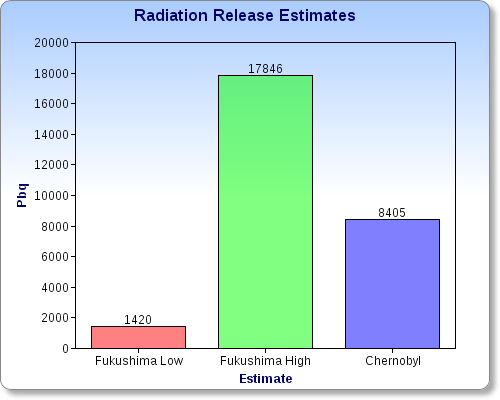
Combined Air & Sea Releases
This is one of the questions we are asked the most, “how much radiation was released from Fukushima”.
Many of the estimates out there are old initial estimates of the meltdown phase and do not include radiation releases over the years.
In our effort to answer this question we found a wide
variety of research and estimates.
With time researchers were able to
use other tools and testing to create a better idea about how much has
been released.
These estimate ranges are presented to give an idea of the
broad range of official estimates and are not a specific scientific
study. What these widely divergent estimates show is that there is a
need for more honest and accurate study of this issue.
Fukushima Vs. Chernobyl
We looked at these two disasters since they are frequently
compared to each other. The extremely high levels, all in petabecquerels
are problematic even if there is a considerable difference between the
two.
These numbers were established by using the range of
estimates that were either “all radiation” or at least included cesium
137 and iodine 131 for the initial phase of the disaster. The estimates
for the years following the accident are based on TEPCO’s admitted
hourly release rates. These totals are for the time period through
December 12, 2013
Air high: 16886 Pbq
Air low: 900 Pbq
Air low: 900 Pbq
These numbers include initial releases and also over time
releases based on oceanography institute estimates. These totals are for
the time period through December 12, 2013
Sea high: 960 Pbq
Sea low: 520 Pbq
Sea low: 520 Pbq
*does not include radiation that escaped via air but fell into the sea or that washed out to sea via rivers.
Fukushima Combined Releases To Sea & Air
Combined high: 17846 Pbq (74.5% of total inventory at the plant)
Combined low: 1420 Pbq (5.9% of total inventory at the plant)
Combined low: 1420 Pbq (5.9% of total inventory at the plant)
The release estimates provided by UNSCEAR were used for comparison.
Air: 8385 Pbq
Sea: 20 Pbq
Combined: 8405 Pbq
Air: 8385 Pbq
Sea: 20 Pbq
Combined: 8405 Pbq
NOTE: There is much more data available on this site, linked in Post Subject.
March
25, 2011 Dr Helmut Hirsh of Greenpeace Germany released a statement
that, according to analysis of radiation released to date, has
reclassified Fukushima at Level 7, comparable to Chernobyl.
April 11, 2011 TEPCO reluctantly admitted that Fukushima was now a Level 7, the worst possible. However, nobody disputes that it is multiple times worse than Chernobyl, yet there isn't any higher measurement. If TEPCO had admitted it sooner, would people have taken other precautionary measures?
The total amount of radionuclides iodine-131 and caesium-137 released since the start of the accident until March 23rd 2011 is so high that they are equal to three class 7 accidents. and it continues until stopped.
Chernobyl had one nuclear reactor and only 3 months of radiation while Fukushima has failures at four nuclear reactors which hold about 1,000 times more radiation than the bombs at Hiroshima, and 40 years of improper nuclear storage and numerous smaller nuclear events. All federal agencies that regulate radioactive exposures agree that any radiation exposure raises the cancer risk. But it isn't JUST cancer, RADIATION EXPOSURE effects your entire health profile.
Chernobyl took aggressive action after only 10 days of burning out of control. They dumped tons of sand and Boron and began entombment procedures. TEPCO worsend the nuclear disaster by adding salt water! Are they that incompetent, do they believe the laws of chemistry cease to exist in Japan, or is there something more deliberate going on? Is this really about protecting future profits?
April 11, 2011 TEPCO reluctantly admitted that Fukushima was now a Level 7, the worst possible. However, nobody disputes that it is multiple times worse than Chernobyl, yet there isn't any higher measurement. If TEPCO had admitted it sooner, would people have taken other precautionary measures?
The total amount of radionuclides iodine-131 and caesium-137 released since the start of the accident until March 23rd 2011 is so high that they are equal to three class 7 accidents. and it continues until stopped.
Chernobyl had one nuclear reactor and only 3 months of radiation while Fukushima has failures at four nuclear reactors which hold about 1,000 times more radiation than the bombs at Hiroshima, and 40 years of improper nuclear storage and numerous smaller nuclear events. All federal agencies that regulate radioactive exposures agree that any radiation exposure raises the cancer risk. But it isn't JUST cancer, RADIATION EXPOSURE effects your entire health profile.
Chernobyl took aggressive action after only 10 days of burning out of control. They dumped tons of sand and Boron and began entombment procedures. TEPCO worsend the nuclear disaster by adding salt water! Are they that incompetent, do they believe the laws of chemistry cease to exist in Japan, or is there something more deliberate going on? Is this really about protecting future profits?
You can know what radiation is in your food, soils or environment by checking with Geiger Counters and Dosimeters
Or assume, as I do, that everything is potentially contaminated and will be for thousands of years. Why not take every health precaution possible to minimize radiation effects?
Subscribe to:
Posts (Atom)